
Foreign Body Ingestion
Medically reviewed by Drugs.com. Last updated on Aug 4, 2025.
What is foreign body ingestion?
Foreign body ingestion means you swallowed an object that is not food. Examples include dental work and button batteries. A foreign body can cause problems as it moves through your digestive system.
What are the signs and symptoms of foreign body ingestion?
- Not wanting to eat
- Drooling or vomiting
- Bloody vomit or rectal bleeding
- Chest pain, abdominal pain, or a feeling that something is stuck
How is foreign body ingestion diagnosed?
Your healthcare provider will examine your throat, chest, and abdomen. Tell your provider the type of object you swallowed and when you swallowed it. Your provider may use any of the following to find the object:
- A barium swallow or other x-rays may be used to check your neck, chest, and abdomen. You will drink thick liquid called barium while providers take x-rays. Barium helps your esophagus and stomach show up on x-rays.
- A metal detector may be used to look for coins or other metal objects in your body.
- A CT may be used to check for objects in your esophagus or stomach. You may be given contrast liquid to help your stomach show up better. Tell the provider if you have ever had an allergic reaction to contrast liquid.
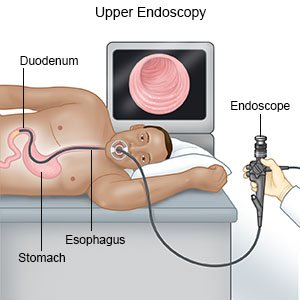
- Endoscopy may be used to see the inside of your digestive system. A scope is a long, bendable tube with a light on the end of it. A camera attached to the scope will take pictures.
How is foreign body ingestion treated?
Your healthcare provider may choose to observe you for 24 hours or longer. You may need x-rays while you wait for the object to come out. If you are in pain or the object is large or sharp, your provider may remove it with any of the following:
- Endoscopy may be used to remove the object.
- Surgery may be needed if other treatments fail to remove the object.
What can I do to manage or prevent foreign body ingestion?
- Search for the object every time you have a bowel movement. Most objects pass through the digestive system and come out in a bowel movement. Objects that are small or smooth will often pass without a problem. Do not use laxatives or stool softeners. Do not force yourself to vomit.
- Make sure dentures or other dental fixtures are secure. You may need to go to the dentist to have dental work repaired.
- Do not hold items between your teeth or in your mouth. For example, do not hold an object such as a toothpick or sewing needle between your teeth.
When should I seek immediate care?
- You have a fever.
- You have severe abdominal pain, nausea, or vomiting.
- Your vomit or saliva is bloody.
- Your bowel movements are black or bloody.
When should I call my doctor?
- You do not find the object in your bowel movement within 3 days.
- You do not want to eat because of abdominal pain or vomiting.
- You are drooling or hoarse.
- You have questions or concerns about your condition or care.
Care Agreement
You have the right to help plan your care. Learn about your health condition and how it may be treated. Discuss treatment options with your healthcare providers to decide what care you want to receive. You always have the right to refuse treatment. The above information is an educational aid only. It is not intended as medical advice for individual conditions or treatments. Talk to your doctor, nurse or pharmacist before following any medical regimen to see if it is safe and effective for you.© Copyright Merative 2025 Information is for End User's use only and may not be sold, redistributed or otherwise used for commercial purposes.
Learn more about Foreign Body Ingestion
Treatment options
Care guides
Further information
Always consult your healthcare provider to ensure the information displayed on this page applies to your personal circumstances.