
Female Condom Use
Medically reviewed by Drugs.com. Last updated on May 6, 2024.
What is a female condom?
A female condom is a soft plastic pouch that goes into your vagina to help prevent pregnancy and sexually transmitted infections (STIs).
How do I put in a female condom?
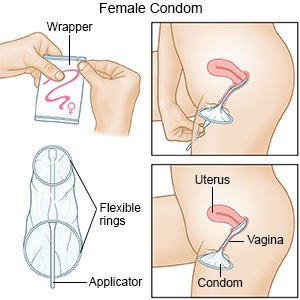 |
- Find a comfortable position to insert the condom. You may sit, squat, or stand with one leg up on a chair.
- Insert the female condom.
- Hold the closed end of the condom and squeeze the inner ring between your thumb and your finger. Put 1 or 2 drops of water-based lubricant or spermicide on the outside of the closed end.
- Use your other hand to separate your labia (folds of skin around the vagina).
- Put the squeezed ring into your vagina and push it up as far as it can go. Place your index or middle finger, or both, inside the open end until the inner ring is felt. Push the inner ring as far back into your vagina as it can go.
- Check the outer ring. Make sure the outer ring is close against the outside area of your vaginal opening. You may need to hold the outer ring as your partner inserts his penis. This helps prevent the entire condom from being pushed into your vagina.
How do I remove a used condom?
- Twist the outer ring. This helps keep the semen inside the condom.
- Gently pull the condom out. Do this before you stand up.
- Throw the condom in the trash. Wrap up the used condom in a paper towel or tissue and put it into the trash. Do not flush it down the toilet.
What else do I need to know about female condoms?
- Use a new condom every time you have sex. It is not washable or reusable.
- Use a female condom with a second form of protection. The best way to protect you and your partner is to use a condom with a sponge, cervical cap, or spermicide. Do not use a female condom while your partner uses a male condom. The 2 condoms may stick together and slip out of place. Ask your healthcare provider for information about other methods of birth control.
- Store condoms in a cool, dry place. Heat may damage the condom. Check the expiration date. Do not use the condom if it is past the expiration date.
When should I call my doctor?
- You have sudden itching or the skin around your vagina becomes red or swollen.
- You have nausea, vomiting, or stomach cramps.
- A condom breaks or leaks during sex.
- You think you may be pregnant.
- You have questions or concerns about your condition or care.
Care Agreement
You have the right to help plan your care. Learn about your health condition and how it may be treated. Discuss treatment options with your healthcare providers to decide what care you want to receive. You always have the right to refuse treatment. The above information is an educational aid only. It is not intended as medical advice for individual conditions or treatments. Talk to your doctor, nurse or pharmacist before following any medical regimen to see if it is safe and effective for you.© Copyright Merative 2024 Information is for End User's use only and may not be sold, redistributed or otherwise used for commercial purposes.
Further information
Always consult your healthcare provider to ensure the information displayed on this page applies to your personal circumstances.
