Consumer Information
Carenotes > External Fixation Of An Ankle Fracture (Inpatient Care)

External Fixation Of An Ankle Fracture

Advertisement

WHAT YOU SHOULD KNOW:

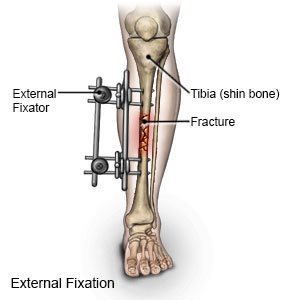
  • External (eks-TER-nal) fixation (fik-SA-shun) of an ankle fracture is surgery to repair your broken ankle. An ankle fracture is a break in any of the bones of your ankle. The ankle joint is made up of the tibia, fibula, and talus bones. The tibia and fibula are the two bones in your lower leg. The talus is a square, flat bone on top of the calcaneus (heel bone). The ankle joint lets you move your foot in different directions. External fixation is done when fractured bones are not in their normal positions or are broken into several pieces. It is also done when bones stick out through skin, or when deep cuts reach down to the bones.
    Lower Leg and Foot


  • With external fixation, pins and devices sticking out of the ankle will hold together broken pieces of bone inside it. While being held together, the pieces of broken bone will grow together and get stronger. This may bring back your ankle's usual appearance and your leg's usual length. Physical activities may need to be avoided for some time until your bone heals completely. It may take months to get full function of your leg, ankle, and foot after this surgery. With external fixation, your ankle fracture may be treated and usual activities may be resumed.

CARE AGREEMENT:

You have the right to help plan your care. To help with this plan, you must learn about your health condition and how it may be treated. You can then discuss treatment options with your caregivers. Work with them to decide what care may be used to treat you. You always have the right to refuse treatment.

RISKS:

There are always risks with surgery, such as bleeding and infection. Other parts of your ankle and foot, such as nerves, blood vessels, ligaments, muscles, and bones may be damaged. Your leg, ankle, or foot may become stiff, numb, and weak. Even after a successful surgery, you may still have ankle pain or problems moving your leg or foot. You may have trouble going back to your usual activities, including sports. If left untreated, the pain and problems you may have with your injury may get worse. Your ankle may be crooked and your legs may not be the same length. Call your caregiver if you are worried or have questions about your surgery, medicine, or care.

WHILE YOU ARE HERE:

Before your surgery:

  • Informed consent: You have the right to understand your health condition in words that you know. You should be told what tests, treatments, or procedures may be done to treat your condition. Your doctor should also tell you about the risks and benefits of each treatment. You may be asked to sign a consent form that gives caregivers permission to do certain tests, treatments, or procedures. If you are unable to give your consent, someone who has permission can sign this form for you. A consent form is a legal piece of paper that tells exactly what will be done to you. Before giving your consent, make sure all your questions have been answered so that you understand what may happen.

  • Anesthesia: Anesthesia is medicine to make you comfortable during surgery. Caregivers work with you to decide which anesthesia is best and whether you will be awake or completely asleep. Do not make important decisions for 24 hours after having anesthesia. Also, do not drive or use heavy equipment. An adult may need to drive you home and stay with you after you have had anesthesia.

  • IV: An IV is a tube placed in your vein for giving medicine or liquids. This tube is capped or connected to tubing and liquid.

  • Pre-op care: You may be given medicine right before your procedure or surgery. This medicine may make you feel relaxed and sleepy. You are taken on a stretcher to the room where your procedure or surgery will be done, and then you are moved to a table or bed.

  • Monitoring:

    • Heart monitor: This is also called an ECG. Sticky pads are placed on different parts of your body. Each pad has a wire that is hooked to a TV-type screen. This shows caregivers a tracing of the electrical activity of your heart.

    • Pulse oximeter: A pulse oximeter is a machine that tells how much oxygen is in your blood. A cord with a clip or sticky strip is placed on your ear, finger, or toe. The other end of the cord is hooked to a machine. Caregivers use this machine to see if you need more oxygen.

    • Vital signs: This includes taking your temperature, blood pressure, pulse (counting your heartbeat), and respirations (counting your breaths). To take your blood pressure, a cuff is put on your arm and tightened. The cuff is attached to a machine which gives your blood pressure reading. Caregivers may listen to your heart and lungs by using a stethoscope. Your vital signs are taken so caregivers can see how you are doing.

During surgery:

  • Your caregiver cleans your leg, ankle, and foot with soap and water. This soap may make your skin yellow, but it will be cleaned off later. Sheets are put over you to keep the area clean.

  • Your caregiver aligns the broken bones together by carefully pushing, pulling, and turning the leg, ankle, or foot. He tries to do this without making a cut on your skin. For hard to reach bones, he may have to make very small cuts on your skin. He may use a fluoroscope (x-ray) to help him insert pins and correctly align the bones. Holes are made on the bones by using a drill to insert screws and long metal pins. These pins are placed through the affected bone and will stick out through your skin. Other rods and devices are attached to them to hold your leg, ankle, and foot steady. An x-ray may be done to see if the bones were set in the right way. Bandages are wrapped around the areas where pins were inserted.

After surgery: You will be taken to a room where you can rest until you wake up. You may be allowed to go home. If you are staying in the hospital, you will be taken back to your room. Do not get out of bed until your caregiver says it is OK. A bandage is used to cover your stitches or staples. This bandage keeps the area clean and dry to prevent infection. A caregiver may remove the bandage soon after surgery to check your incision.

  • Diet: You may be able to eat when bowel sounds are heard. Your caregiver will listen to your stomach for bowel sounds using a stethoscope. You may be given ice chips at first, and then liquids such as water, broth, juice, or soda pop. If you do not have problems after drinking liquids, caregivers may then give you soft foods. Some examples of soft foods are ice cream, applesauce, or custard. Once you can eat soft food easily, you may begin eating your usual diet.

  • Medicines: You may need one or more of the following:

    • Antibiotics: Antibiotics may be given to help treat or prevent an infection caused by germs called bacteria.

    • Antinausea medicine: This medicine may be given to calm your stomach and control vomiting (throwing up). Pain medicine may upset your stomach and make you feel like vomiting. Because of this, pain medicine and anti-nausea medicine are often given at the same time.

    • Pain medicine: Caregivers may give you medicine to take away or decrease your pain. Medicine may be given regularly, or may only be given if you ask caregivers for it. Tell caregivers if your pain does not decrease enough for you to feel better. Do not wait to ask for your pain medicine until the pain is very bad. The medicine may not work as well at controlling your pain if you wait too long to take it. Ask your caregiver for help getting out of bed if you feel tired or dizzy.

Copyright © 2008 Thomson Healthcare Inc. All rights reserved. Information is for End User's use only and may not be sold, redistributed or otherwise used for commercial purposes.

The above information is an educational aid only. It is not intended as medical advice for individual conditions or treatments. Talk to your doctor, nurse or pharmacist before following any medical regimen to see if it is safe and effective for you.


MedNotes
Advertisement

(web2)