Cystectomy With Continent Cutaneous Urinary Diversion
What you should know
Cystectomy With Continent Cutaneous Urinary Diversion (Precare) Care Guide
- Cystectomy With Continent Cutaneous Urinary Diversion Discharge Care
- Cystectomy With Continent Cutaneous Urinary Diversion Inpatient Care
- Cystectomy With Continent Cutaneous Urinary Diversion Precare
- En Espanol
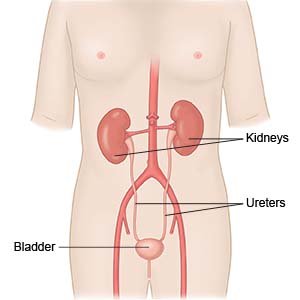
- Cystectomy (sis-tek-tuh-me) with continent cutaneous urinary diversion (bypass) is surgery to remove your bladder. A new bladder or "reservoir" (reh-zih-vor) is made from a piece of your intestine. The ureters (tubes that go from the kidney to the bladder) are sewed into this new bladder. The end of the new bladder will come out of a hole in the skin on your abdomen. This is called a stoma.
- You may need this surgery if you have cancer of the bladder. This surgery may be able to cure the cancer. You may need this surgery after an accident or illness, such as one that caused you to become paralyzed. You will need to put a catheter (thin bendable tube) into the stoma around 5 times a day to drain the urine.
Care Agreement
You have the right to help plan your care. Learn about your health condition and how it may be treated. Discuss treatment options with your caregivers to decide what care you want to receive. You always have the right to refuse treatment.
Risks
- There are always risks with surgery. You may bleed more than usual or get an infection. Urine could leak where the ureters are connected to the section of intestine. Or, there could be a blockage in the ureters so urine cannot drain from the kidneys. Caregivers will watch you closely and work with you to fix these problems.
- You may get a blood clot in your leg or arm. This can cause pain and swelling, and it can stop blood from flowing where it needs to go in your body. The blood clot can break loose and travel to your lungs or brain. A blood clot in your lungs can cause chest pain and trouble breathing. A blood clot in your brain can cause a stroke. These problems can be life-threatening.
- But if you don't have surgery, your problem could get worse. If you have cancer and the bladder is not taken out, the cancer could spread and you could die. Call your caregiver if you have questions or concerns about your medicine or care.
Getting Ready
- The Week Before Surgery:
- Ask your caregiver if you need to stop taking aspirin or any other blood thinning medicines before your procedure.
- Ask your caregiver before taking any over-the-counter medicine, such as laxatives.
- You may be given a tour of the ICU before your surgery to help you become familiar with where you will go after surgery.
- You may need blood tests before your procedure. Talk to your caregiver about these or other tests you may need. Write down the date, time and location for each test.
- You may be able to donate your own blood before surgery. This is called autologous (ah-tall-uh-gus) blood donation. This must be done no later than 3 days before surgery. Or, you may also ask a family member or friend with the same blood type to donate their blood. This is called directed blood donation. Talk to your caregiver for more information on autologous or directed blood donation.
- Your caregiver may want you to empty and clean out your bowel before surgery. Doing this will help to keep your bowel from getting infected after surgery. Your caregiver may ask you to do one or more of the following things.
- Eat high fiber foods for 1 to 2 days before surgery. Good examples of high fiber foods are fruits, vegetables, cereal, and bread. Also, drink 6 to 8 glasses (soda-pop can size) of water daily.
- Drink a special liquid called a cathartic (kuh-thar-tik) the day before surgery. This will give you diarrhea but cleans out your bowel quickly.
- Take antibiotic (an-ti-bi-ah-tik) medicine before surgery if given to you by your caregiver.
- You may need to have an enema the day before surgery. This is liquid put into your rectum (rear end) to help empty your bowel. Your caregiver will tell you how to do this.
- Eat high fiber foods for 1 to 2 days before surgery. Good examples of high fiber foods are fruits, vegetables, cereal, and bread. Also, drink 6 to 8 glasses (soda-pop can size) of water daily.
- Ask your caregiver if you need to stop taking aspirin or any other blood thinning medicines before your procedure.
- The Night Before Surgery:
- You may be given a pill to take to help you sleep.
- Ask caregivers about directions for eating and drinking.
- You may be given a pill to take to help you sleep.
- The Day of Surgery:
- Write down the correct date, time, and location of your surgery.
- Ask your caregiver before taking any medicine on the day of surgery. These medicines include insulin, diabetic pills, high blood pressure pills, or heart pills. Bring a list of your medicines or the pill bottles with you to the hospital.
- Do not wear contact lenses the day of surgery. You may wear your glasses.
- If you are staying in the hospital after surgery, bring your personal belongings with you. These include your bathrobe, toothbrush, denture cup (if needed), hairbrush, and slippers. Do not wear jewelry or bring money to the hospital.
- An anesthesiologist (an-iss-thee-z-all-o-jist) may talk to you before your surgery. This is the caregiver who gives you medicine before and during surgery so that you do not feel or remember the surgery.
- Informed Consent:
- You have the right to understand your health problem. In words you can understand, you should be told what tests, treatments, or procedures may be done to treat your problem. Your doctor should also tell you about the risks and benefits of each treatment.
- You may be asked to sign a consent form. If you are unable to give your consent, someone who has permission can sign this form for you. A consent form is a legal piece of paper that gives your doctor permission to do certain tests, treatments, or procedures. This form should tell you exactly what will be done to you. Your doctor should tell you what the risks and benefits of each treatment are before you sign the form. Before giving your consent, make sure all your questions have been answered so that you understand what may happen.
- You have the right to understand your health problem. In words you can understand, you should be told what tests, treatments, or procedures may be done to treat your problem. Your doctor should also tell you about the risks and benefits of each treatment.
- Write down the correct date, time, and location of your surgery.
Treatment
- What Will Happen: You will be asked to change into a hospital gown. You may be given medicine in your IV to help you relax or make you drowsy. You will be taken on a cart to the operating room. You will get general anesthesia to keep you completely asleep. Caregivers clean your abdomen (belly) with soap and water. This soap may make your skin yellow, but is cleaned off later. Sheets are put over you to keep the surgery area clean. An incision (cut) is made in your abdomen and your bladder is removed.
- The prostate (prah-stat) gland, seminal vesicles, and part of the ureters in men may also be removed. The prostate gland is a male sex gland that helps make semen. It wraps around the neck of the bladder. The seminal vesicles make fluid to help the sperm grow. In women the uterus (womb), cervix (opening of the uterus) and the top part of the vagina may be removed.
- A section of intestine is separated from the rest of the intestines and used to make a new bladder. The ureters are connected to this section of intestine. Two small tubes called stents are put through the ureters into the kidney to drain urine while you heal after surgery. One end of the new bladder is brought outside through the a hole in the skin of the abdomen. This is called a stoma. Or, another piece of tissue like the appendix is used to connect the end of the new bladder to the skin near your umbilicus (belly button). Then the incision in your abdomen is closed with stitches (thread) or staples.
- The prostate (prah-stat) gland, seminal vesicles, and part of the ureters in men may also be removed. The prostate gland is a male sex gland that helps make semen. It wraps around the neck of the bladder. The seminal vesicles make fluid to help the sperm grow. In women the uterus (womb), cervix (opening of the uterus) and the top part of the vagina may be removed.
- After Surgery: You will be taken to a recovery room. You will be there until you wake up. You will then be able to go home or will be taken back to your room. A bandage will cover your stitches/staples. Do not get out of bed until your caregiver says it is OK.
- Waiting Room: This is a room where your family can wait until you are ready for visitors after surgery. Your doctor or nurse can then find them to let them know how the surgery went. If your family leaves the hospital, ask them to leave a phone number where they can be reached. When it is time for you to go home after your surgery, someone will need to drive you home. Do not drive home alone. An adult should stay with you for at least 24 hours after surgery.
Contact a caregiver if
- You cannot make it to your surgery appointment on time.
- You have questions or concerns about your surgery.
- You have a fever.
- The problems for which you are having surgery get worse.
Copyright © 2012. Thomson Reuters. All rights reserved. Information is for End User's use only and may not be sold, redistributed or otherwise used for commercial purposes.
The above information is an educational aid only. It is not intended as medical advice for individual conditions or treatments. Talk to your doctor, nurse or pharmacist before following any medical regimen to see if it is safe and effective for you.