Thomson Reuters Micromedex

Creutzfeldt-jakob Disease

WHAT YOU SHOULD KNOW:

Creutzfeldt-jakob Disease (Inpatient Care) Care Guide

  • Creutzfeldt-Jakob disease, or CJD, is a disease of the nervous system. The nervous system includes the brain, spine, and nerves. With CJD, the cells and tissues of the nervous system are damaged. This results in loss of mental, emotional and physical functions. CJD is caused by a form of a protein known as prion. Prions are normally found in the cells and tissues of many body organs including the brain.

  • CJD can affect anyone but is most common in people 50 to 70 years of age. You can get this disease from organ transplants or contaminated (dirty) surgical instruments. Brain biopsy and lumbar puncture to test the cerebrospinal fluid (fluid in the brain) are used to diagnose CJD. Other tests may include an electroencephalogram (EEG) and magnetic resonance imaging (MRI) of the brain. There is no cure for CJD. CJD signs and symptoms tend to worsen quickly. Treatment is usually given to decrease symptoms. Supportive therapies are often needed to help you continue with your usual activities for as long as possible.

CARE AGREEMENT:

You have the right to help plan your care. Learn about your health condition and how it may be treated. Discuss treatment options with your caregivers to decide what care you want to receive. You always have the right to refuse treatment.

RISKS:

Signs and symptoms of CJD often get worse as the disease continues and may eventually lead to death. Supportive treatment and therapies are often given to decrease symptoms and may offer relief. Ask your caregiver if you have questions about your condition and treatment options.

WHILE YOU ARE HERE:

Informed consent:

A consent form is a legal document that explains the tests, treatments, or procedures that you may need. Informed consent means you understand what will be done and can make decisions about what you want. You give your permission when you sign the consent form. You can have someone sign this form for you if you are not able to sign it. You have the right to understand your medical care in words you know. Before you sign the consent form, understand the risks and benefits of what will be done. Make sure all your questions are answered.

Eating and swallowing:

Your doctor may ask a swallowing therapist to work with you if you have trouble swallowing. This person has special training to help people learn safer ways to swallow. The swallowing therapist will also help you learn which foods and liquids are safe to eat and drink.

  • You may be fed by an IV or a nasogastric (NG) tube if your swallowing problems are very bad. An NG tube is put in through your nose and goes down into your stomach. The tube may also go directly from the outside of your body into your stomach. This is called a gastrostomy tube.

  • You may be given thickened liquids to drink because they may be easier for you to swallow. A special powder is used to thicken liquids. You may also be able to eat softer (mashed) foods. You may be able to eat what you usually eat when your swallowing gets better.

Neurologic exam:

This is also called neuro signs, neuro checks, or neuro status. A neurologic exam can show caregivers how well your brain works after an injury or illness. Caregivers will check how your pupils (black dots in the center of each eye) react to light. They may check your memory and how easily you wake up. Your hand grasp and balance may also be tested.

Medicines:

You may have any of the following for the relief of your symptoms:

  • Antianxiety medicine: This medicine may be given to decrease anxiety and help you feel calm and relaxed.

  • Immune globulins: This medicine is given as a shot or an IV infusion to make your immune system stronger. You may need immune globulins to treat or prevent an infection. It is also used when you have a chronic condition, such as lupus or arthritis. You may need many weeks of treatment. Each infusion can take from 2 to 5 hours.

  • Muscle relaxers: This medicine helps relax your muscles. It is also given to decrease pain and muscle spasms.

  • Pain medicine: Caregivers may give you medicine to take away or decrease your pain.

    • Do not wait until the pain is severe to ask for your medicine. Tell caregivers if your pain does not decrease. The medicine may not work as well at controlling your pain if you wait too long to take it.

    • Pain medicine can make you dizzy or sleepy. Prevent falls by calling a caregiver when you want to get out of bed or if you need help.

Tests:

You may have one or more of the following:

  • Biopsy: This is a procedure where a small piece of tissue from your brain is collected and sent to the lab for tests.

  • Blood tests: You may need blood taken to give caregivers information about how your body is working. The blood may be taken from your hand, arm, or IV.

  • EEG: This test is also called an electroencephalogram. Many small pads or metal discs are put on your head. Each has a wire that is hooked to a machine. This machine prints a paper tracing of brain wave activity from different parts of your brain. Caregivers look at the tracing to see how your brain is working.

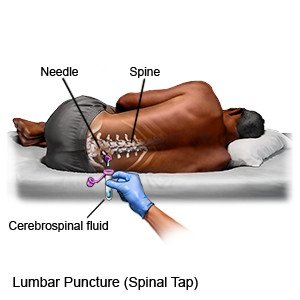
  • Lumbar puncture: This procedure may also be called a spinal tap. During a lumbar puncture, you will need to lie very still. Caregivers may give you medicine to make you lose feeling in a small area of your back. Caregivers will clean this area of your back. A needle will be put in, and fluid removed from around your spinal cord. The fluid will be sent to a lab for tests. The tests check for infection, bleeding around your brain and spinal cord, or other problems. Sometimes medicine may be put into your back to treat your illness.

  • MRI: This scan uses powerful magnets and a computer to take pictures of your brain. It will also take pictures of the blood vessels and structures in your head. You may be given dye, also called contrast, before the test. Tell caregivers if you are allergic to dye, iodine, or seafood. Remove all jewelry, and tell caregivers if you have any metal in or on your body. Metal can cause serious injury. Tell caregivers if you cannot lie still or are anxious or afraid of closed spaces.

Copyright © 2012. Thomson Reuters. All rights reserved. Information is for End User's use only and may not be sold, redistributed or otherwise used for commercial purposes.

The above information is an educational aid only. It is not intended as medical advice for individual conditions or treatments. Talk to your doctor, nurse or pharmacist before following any medical regimen to see if it is safe and effective for you.

Learn more about Creutzfeldt-jakob Disease (Inpatient Care)

Advertisement
Close

Recommended

(web6)