
Contusion in Children
Medically reviewed by Drugs.com. Last updated on May 6, 2024.
A contusion is a bruise that appears on your child's skin after an injury. A bruise happens when small blood vessels tear but skin does not. Blood leaks into nearby tissue, such as soft tissue or muscle.
DISCHARGE INSTRUCTIONS:
Seek care immediately if:
- Your child cannot feel or move his or her injured arm or leg.
- Your child begins to complain of pressure or a tight feeling in his or her injured muscle.
- Your child suddenly has more pain when he or she moves the injured area.
- Your child has severe pain in the area of the bruise.
- Your child's hand or foot below the bruise gets cold or turns pale.
Call your child's doctor if:
- The injured area is red and warm to the touch.
- Your child's symptoms do not improve after 4 to 5 days of treatment.
- You have questions or concerns about your child's condition or care.
Medicines:
- NSAIDs , such as ibuprofen, help decrease swelling, pain, and fever. This medicine is available with or without a doctor's order. NSAIDs can cause stomach bleeding or kidney problems in certain people. If your child takes blood thinner medicine, always ask if NSAIDs are safe for him or her. Always read the medicine label and follow directions. Do not give these medicines to children younger than 6 months without direction from a healthcare provider.
- Prescription pain medicine may be given. Do not wait until the pain is severe before you give your child more medicine.
- Do not give aspirin to children younger than 18 years. Your child could develop Reye syndrome if he or she has the flu or a fever and takes aspirin. Reye syndrome can cause life-threatening brain and liver damage. Check your child's medicine labels for aspirin or salicylates.
- Give your child's medicine as directed. Contact your child's healthcare provider if you think the medicine is not working as expected. Tell the provider if your child is allergic to any medicine. Keep a current list of the medicines, vitamins, and herbs your child takes. Include the amounts, and when, how, and why they are taken. Bring the list or the medicines in their containers to follow-up visits. Carry your child's medicine list with you in case of an emergency.
Help your child's contusion heal:
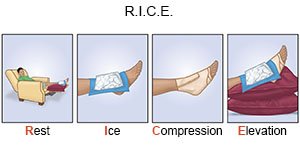 |
- Have your child rest the injured area or use it less than usual. If your child bruised a leg or foot, crutches may be needed. This will help your child keep weight off the injured body part.
- Apply ice to decrease swelling and pain. Ice may also help prevent tissue damage. Use an ice pack, or put crushed ice in a plastic bag. Cover it with a towel and place it on your child's bruise for 15 to 20 minutes every hour or as directed.
- Use compression to support the area and decrease swelling. Wrap an elastic bandage around the area over the bruised muscle. Make sure the bandage is not too tight. You should be able to fit 1 finger between the bandage and your child's skin.
- Elevate (raise) the area above the level of your child's heart to help decrease pain and swelling. Use pillows, blankets, or rolled towels to elevate the area as often as you can.
- Do not let your child stretch injured muscles right after the injury. Ask your child's healthcare provider when and how your child may safely stretch after the injury. Gentle stretches can help increase your child's flexibility.
- Do not massage the area or put heating pads on the bruise right after the injury. Heat and massage may slow healing. Your child's healthcare provider may tell you to apply heat after several days. At that time, heat will start to help the injury heal.
Prevent contusions:
- Do not leave your baby alone on the bed or couch. Watch him or her closely as he or she starts to crawl, learns to walk, and plays.
- Make sure your child wears proper protective gear. These include padding and protective gear such as shin guards. He or she should wear these when he or she plays sports. Teach your child about safe equipment and places to play, and teach him or her to follow safety rules.
- Remove or cover sharp objects in your home. As a very young child learns to walk, he or she is more likely to get injured on corners of furniture. Remove these items, or place soft pads over sharp edges and hard items in your home.
Follow up with your child's doctor as directed:
Write down your questions so you remember to ask them during your visits.
© Copyright Merative 2024 Information is for End User's use only and may not be sold, redistributed or otherwise used for commercial purposes.
The above information is an educational aid only. It is not intended as medical advice for individual conditions or treatments. Talk to your doctor, nurse or pharmacist before following any medical regimen to see if it is safe and effective for you.
Learn more about Contusion
Care guides
Further information
Always consult your healthcare provider to ensure the information displayed on this page applies to your personal circumstances.
