Colostomy Care
WHAT YOU SHOULD KNOW:
Colostomy Care (Aftercare Instructions) Care Guide
- Colostomy Care
- Colostomy Care Aftercare Instructions
- Colostomy Care Discharge Care
- En Espanol
A colostomy is an opening that is made in the colon with surgery. After the opening is made, the colon is then brought to the surface of the abdomen to allow stools to leave your body. The opening at the surface of the abdomen is called a stoma. The stool leaves the colon through the stoma and drains into a flat, changeable, watertight bag or pouch. The pouch is attached to the skin with an adhesive (substance that seals the pouch to the skin). A colostomy is sometimes needed for cancer, diverticular disease, Crohn's disease and trauma or injury. A temporary colostomy may be needed to allow the colon to rest and heal for a period of time. A temporary colostomy may be in place for weeks, months, or years. The temporary colostomy will eventually be closed and bowel movements will return to normal. A permanent colostomy is usually needed when a part of the colon must be removed or cannot be used again.
![]() |
INSTRUCTIONS:
Medicines:
- Keep a current list of your medicines: Include the amounts, and when, how, and why you take them. Take the list or the pill bottles to follow-up visits. Carry your medicine list with you in case of an emergency. Throw away old medicine lists. Use vitamins, herbs, or food supplements only as directed.
- Take your medicine as directed: Call your primary healthcare provider if you think your medicine is not working as expected. Tell him about any medicine allergies, and if you want to quit taking or change your medicine.
- Your stool may pass through your intestine more quickly than before you had your colostomy. So, some medicines are not absorbed (used up) by your intestine. Call your caregiver if you see pills in your ostomy pouch or stool. Tell your caregiver and your pharmacist that you have a colostomy. They can order the kind of medicine that is used best by your intestine.
- You should not use laxatives because your bowel movements (BM's) are already soft. Tell caregivers that you have a colostomy so laxatives will not be ordered before a test or surgery unless needed.
Follow-up visit information:
Keep all appointments. Write down questions you have about having a colostomy. This will help you to remember to ask these questions during your next visit. Your stoma may change over time depending on things like gaining or losing weight. Caregivers will measure and check your stoma and ostomy. Bring your ostomy equipment with you to your appointments and anytime you have to go to the hospital.
Caring for the skin around the stoma:
A good time to check your stoma and the skin around it is when you change your pouch. The stoma is always pink or red and moist (wet) looking. Because your stoma has many small blood vessels, it may bleed when it is cleaned and wiped. You should not worry about a little bleeding unless the bleeding does not stop. As swelling goes away, your stoma size should get smaller and should be its normal size in about eight weeks.
- The part of your colostomy pouch that sticks to your abdomen is called a skin barrier. It is important that the skin barrier opening for your stoma fit closely (not closer than one-eighth of an inch) up to the stoma. Use the stoma-measuring guide that comes with your colostomy supplies to check the size of your stoma. As your stoma gets smaller, you will also want to cut the skin barrier opening smaller. Stool can leak through the opening onto your skin if the opening is too large. The stool may then cause your skin to be red and irritated.
- Red skin may also mean that the skin barrier was left on too long. It is always important to learn why the skin around your stoma is red or irritated. Talk to your caregiver about what to do about red and irritated skin.
Changing the pouch:
There are many types of ostomy pouches including one-piece, two-piece, disposable, reusable, cut-to-fit, or pre-cut. Your ostomy nurse or caregiver can help you decide which type would best for you. The way in which you should change your colostomy pouch depends on the type of pouch you use. Your caregiver will give you specific instructions on how to change your colostomy pouch. Below you will find some general information about how to change your pouch:
- Ask your caregiver about how often to change your colostomy pouch. The amount of time that you should leave your pouch on your abdomen depends on many things. The type of pouch you wear affects the amount of time you can wear a pouch. The kind and amount of stool you have also affects how long the pouch stays on.
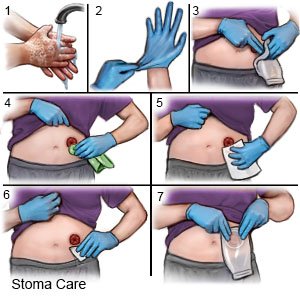
- If you are wearing an open-ended pouch, empty the contents from pouch into the toilet. Gently remove the pouch by pushing the skin down and away from the adhesive skin barrier with one hand. With the other hand, pull the pouch up and away from the stoma.
- Clean the skin around the stoma with warm water. You may also use soap but do not use soaps that have oil or perfumes. Pat your skin dry.
- Use a pouch that has an opening that is one-eighth of an inch larger than the stoma.
- Use skin protection products if you have irritated skin around the stoma. The skin can be treated with these products to protect your skin and create a dry surface.
- Center the pouch over the stoma and press it firmly into place on clean, dry skin. It may be helpful to hold your hand over the newly applied pouch for 30 seconds. The warmth of your hand can help to mold the adhesive skin barrier into place.
- Place the old pouch in another plastic bag to be thrown away if the pouch is disposable. If you use a reusable pouch, talk to your caregiver about how to clean the reusable pouch.
Emptying the pouch:
- Empty the pouch when one-third to one-half full. Do not wait until the pouch is completely full because this could put pressure on the seal, causing a leak. The pouch may also detach, causing all of the pouch contents to spill.
- Place toilet paper into the toilet to reduce splash back and noise.
- Take the end of the pouch and hold it up. Remove the clamp (if the pouch has a clamp system).
- Take the end of the end of the pouch and make a cuff to keep it from getting soiled. Some pouches will not require you to cuff the pouch.
- Drain the pouch by squeezing the pouch contents into the toilet.
- Clean the cuffed end of the pouch with toilet paper or a moist paper towel. You may also rinse the pouch but it is not necessary. Make sure and keep the end of the pouch clean.
- Undo the cuff at the end of the pouch. Replace the clamp or close the end of the pouch according to your caregiver's instructions.

Irrigating the colostomy:
Ask a specially trained caregiver such as an ostomy nurse how to properly irrigate your colostomy. Below are some general steps for irrigation:
- You will need a plastic irrigating container with a long tube and a cone to introduce water into the colostomy. You will also need an irrigation sleeve that will direct the output into the toilet. You will need an adjustable belt to attach the irrigation sleeve and a tail closure for the end of the sleeve.
- Find a consistent time of day when you can irrigate and not be interrupted.
- Fill the irrigating container with about 16 to 50 ounces of lukewarm water. The water should not be cold or hot. The amount of water each person needs to put in the irrigating container varies. Ask your caregiver how much water you will need to irrigate. Hang the irrigation container at a height in which the bottom of the container is level with your shoulder. Sit up straight on the toilet or on a chair next to the toilet.
- Take the adjustable belt and attach it to the irrigation sleeve. Place the belt around your waste and place the sleeve over your stoma. Place the end of the irrigation sleeve into the toilet bowel.
- Release air bubbles from the tubing on the plastic irrigating container by releasing the clamp. Allow a small amount of water to be released into the sleeve. Clamp the tubing again.
- Moisten the end of the cone with water or lubricate it with water-soluble lubricant.
- Place the tip of the cone about three inches deep into the stoma. Make sure there is a snug fit but do not place the cone too deeply or forcefully into the stoma. Release the clamp on the tubing again and allow the water to flow into the stoma. The water must go in slowly and takes about five to ten minutes. Keep the cone in place for another 10 seconds.
- Remove the cone from the stoma. Allow the output to drain into the irrigation sleeve for about 10 to 15 minutes. Dry the end of the irrigation sleeve. Clip the bottom of the sleeve to the top with a clasp or close the end of the sleeve with the tail closure. You may move around for about 30 to 45 minutes until all the water and stool has drained. Drain the output from the sleeve into the toilet. Clean the area around the stoma with mild soap and water and pat dry.
Problems that can happen with a stoma:
Most stoma problems happen during the first year after surgery.
- Stoma retraction: Retraction happens when the height of the stoma goes down to the skin level or below the skin level. Retraction may happen soon after surgery because the colon does not become active soon enough. Retraction may also happen because of weight gain. The pouching system must be changed to match the change in stoma shape.
- Peristomal hernia: Peristomal hernias occur when part of the bowel (colon) bulges into the area around the stoma. Hernias are most obvious during times when there is pressure on the abdomen. For example, the hernia may be more obvious when sitting, coughing, or straining. Hernias may make it difficult to create a proper pouch seal or to irrigate. The hernia may be managed with a hernia belt. Changes may also need to be made to the pouching system to create a proper seal. Surgery may also be done in some people.
- Prolapse: A prolapse means the bowel becomes longer and protrudes out of the stoma and above the abdomen surface. The stomal prolapse may be caused by increased abdominal pressure. Surgery may be done to fix the prolapse in some people.
- Stenosis: A stenosis is a narrowing or tightening of the stoma at or below the skin level. The stenosis may be mild or severe. A mild stenosis can cause noise as stool and gas is passed. Severe stenosis can cause obstruction (blockage) of stool. If the stoma is mild, a caregiver may enlarge it by stretching it with his finger. If the stenosis is severe, surgery is usually needed.
Diet:
- People with colostomies can eat a regular diet. Choose healthy foods from all the food groups. To avoid constipation, eat foods such as oatmeal, whole-grain breads and cereals, fruits and vegetables. There may be some foods that you cannot tolerate very well. If a food gives you cramps or diarrhea, do not include that food in your diet. Try the food again in a few weeks. Eat small portions first and then gradually increase your portion sizes.
- You may want to avoid foods that cause gas and odor. Some foods that may cause gas and odor are vegetables such as broccoli, cabbage, and cauliflower. Other foods include beans, eggs, and fish. You can also reduce gas by eating slowly and not using straws to drink liquids. Foods that may help to control odor and gas in some people are fresh parsley, yogurt and buttermilk.
- Drink at least 8 to 10 (eight ounce) cups of water each day. Follow your caregiver's advice if you must limit the amount of liquids you drink. Healthy liquids to drink are water, juices, and milk. Limit the amount of caffeine you drink, such as coffee, tea, and soda.
Living with a colostomy:
- Work: You can go back to work when your caregiver says it is OK. You may need special support to prevent a hernia if you work is heavy labor, such as lifting or digging. You may need an ostomy belt over the pouch to keep it in place if you move a lot at your job.
- Exercise: Exercise is very important. Talk to your caregiver about an exercise program once you feel stronger. Together you can plan a program that works for you. It is best to start slowly and do more as you get stronger. Exercising makes the heart stronger, lowers blood pressure, and helps keep you healthy. Your body and mind should feel better after exercising. Walking, jogging, bicycling, and swimming are good exercises. Talk with your caregiver before playing contact sports. You may need to wear a special support or a colostomy cover to protect your stoma. Empty your pouch before playing sports.
- Bathing or swimming: You may take a bath with or without your pouch. You can take a shower or bath with your pouch off. Water will not go into the stoma during a shower or bath. For swimming, you should always wear your pouch. Empty your pouch before getting into the water if you swim. You may want to put waterproof tape strips over the edges of your skin barrier.
- Relationships:
- You may feel anxious, nervous, or scared when you first start to care for your colostomy. You may not like the way your body looks. You may feel like you are no longer in control of your body. These are normal feelings and should improve with time. Talk to someone close to you or to your caregiver about these feelings.
- Learning to live with a colostomy may be difficult for both you and your spouse. Together you can find ways to live with this change in your life. It will take time for you to feel better after surgery. If you had an active sex life before colostomy surgery, it can be the same after surgery. You cannot hurt your stoma by having close body contact. Be sure to empty the pouch before having sex.
- You may feel anxious, nervous, or scared when you first start to care for your colostomy. You may not like the way your body looks. You may feel like you are no longer in control of your body. These are normal feelings and should improve with time. Talk to someone close to you or to your caregiver about these feelings.
- Traveling: Always carry extra colostomy supplies and pouches with you when traveling. Take enough supplies for your trip. You may not be able to find what you need while traveling. Contact your local ostomy group or ostomy nurse for help. They may be able to give you a list of ostomy caregivers in the area you are visiting.
- If you fly, pack your supplies in your carry-on luggage not your checked suitcase because luggage is sometimes lost or delayed. Adhesive remover solution may not be allowed on the plane. Take adhesive remover packets with you instead.
- If you drive, do not put your supplies in the trunk or glove compartment. This can cause your supplies to get hot, melt and not stick well. Keep your ostomy supplies in the coolest place in the car.
- If you fly, pack your supplies in your carry-on luggage not your checked suitcase because luggage is sometimes lost or delayed. Adhesive remover solution may not be allowed on the plane. Take adhesive remover packets with you instead.
CONTACT A CAREGIVER IF:
- You have a fever.
- Unusual odor that lasts longer than a week.
- Your skin around the stoma is red and irritated and you do not know what to do.
- You have nausea, vomiting, pain, cramping, or bloating.
- You have diarrhea.
- Your bowel habits change, like having little or no stool output.
- Your stoma size changes or becomes narrow (stenosis).
- Your stools are black or bloody.
- You have questions or concerns about your colostomy, medicines, or colostomy supplies.
SEEK CARE IMMEDIATELY IF:
- Your stoma is bleeding and you cannot stop the bleeding.
- You are too weak to stand up.
- You have bad abdominal (belly) pain.
Copyright © 2012. Thomson Reuters. All rights reserved. Information is for End User's use only and may not be sold, redistributed or otherwise used for commercial purposes.
The above information is an educational aid only. It is not intended as medical advice for individual conditions or treatments. Talk to your doctor, nurse or pharmacist before following any medical regimen to see if it is safe and effective for you.
Learn more about Colostomy Care (Aftercare Instructions)
Micromedex Care Notes: