
Child Safety Seats
Medically reviewed by Drugs.com. Last updated on Aug 4, 2025.
What is a child safety seat?
A child safety seat is a padded seat that secures infants and children while they ride in a car. Every child safety seat has age, height, and weight ranges. Keep using the safety seat until your child reaches the maximum of the range. Then he or she is ready for the child safety seat that is the next size up. Continue to follow this pattern until your child can use a seatbelt safely.
Why are child safety seats important?
Child safety seats are made to protect your child against an injury in an accident. Injuries from car accidents are a leading cause of death in children. Injuries and death can often be prevented if a child is secured in the appropriate safety seat. Always set a good example for your children by wearing your own seatbelt.
What do I need to know about child safety seats?
You will need to move the child safety seat to any other car your child will be riding in. Follow the instructions for installing and using your specific child safety seat. Directions for one type may not work for another type.
- Safety seats include rear-facing, forward-facing, convertible, and booster seats. Your infant will start with a rear-facing infant safety seat. He or she will grow into a forward-facing seat. Convertible seats start as rear-facing and can be converted into forward-facing seats when your child is a safe size. He or she will move to a booster seat over time.
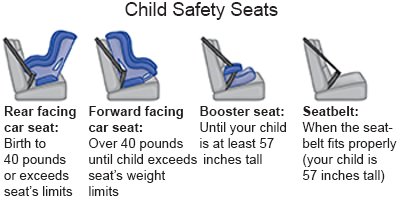
- Choose a seat that meets the Federal Motor Vehicle Safety Standard 213. The seat will have a label stating that it meets this standard. The seat will also state an expiration date. Do not use the seat past this date.
- Do not use any other type of seat. Only use child safety seats. Do not use a toy chair or prop your child on books or other objects.
- Make sure the child safety seat has a harness and clip. The harness is made of straps that go over your child's shoulders. The straps connect to a buckle that rests over your child's abdomen. These straps keep your child in the seat during an accident. Another strap comes up from the bottom of the seat and connects to the buckle between your child's legs. This strap keeps your child from slipping out of the seat. Slide the clip up and down the shoulder straps to make them tighter or looser. You should be able to slip a finger between your child and the strap.
- Do not reuse a child safety seat. Over time, child safety seats become less effective. They may develop cracks or lose parts that are needed for safety. Replace the child safety seat after an accident. Never use a seat given to you after it was in a car that had an accident. You can also check with the manufacturer to see if the seat was recalled.
- The child safety seat may have a top tether. A tether is a strap at the top of the seat. It connects to the back seat of some cars. This helps keep the seat in place during an accident.
How will I know my child safety seat is properly secured?
The best spot to place your child safety seat is in the middle of the back seat. The safety seat should not move more than 1 inch in any direction after you secure it. If the safety seat is not installed tightly, your child may be injured by the movement in an accident. Always follow the instructions provided to help you position the safety seat. The instructions will also guide you on how to secure your child properly.
When should I use a rear-facing child safety seat?
Rear-facing child safety seats should be used from birth until 2 to 4 years of age. This will depend on your child's height and weight.
- Your infant will ride in only a rear-facing child safety seat. Use it until your child reaches the maximum weight or height provided by the manufacturer.
- Secure your child in the rear-facing safety seat in the back seat of your car. It is okay if his or her feet touch the back of the car seat. Check the instructions to see if it is okay for the safety seat to touch the back of the seat in front of it.
- The safety seat will be tilted back. This will allow your child's head to rest against the back of the safety seat. You may need to adjust the angle of the seat if your child's head is propped forward. Check the instructions to find the correct angle for the seat. Make sure the harness straps are not loose. Make sure the chest clip is at the center of your child's chest. The chest clip should be at the same level as your child's armpits.
- You can prop rolled towels around your baby to keep him or her from slouching or falling over in the seat. Do not put the towels under or behind your baby. Do not use a safety seat insert unless it came with the child safety seat. Make sure your child is dressed in thin layers of clothing while in the safety seat. Thick coats or jackets can cause the straps to be too loose in an accident.
When should I use a forward-facing child safety seat?
Forward-facing child safety seats should be used until at least 5 years of age.
- Have your child use a forward-facing safety seat that has a harness. Your child should use a safety seat with a harness until he or she is at least 4 years old.
- Your child must use the forward-facing safety seat until he or she reaches the seat's maximum weight and height.
- Some forward-facing safety seats convert into booster seats. Your child can continue to use this seat without the harness after he or she outgrows the harness. Your child can use it this way until he or she reaches the maximum weight and height provided by the manufacturer.
- Your child needs to be secured in the safety seat in the back seat of the car. Use the top tether if the safety seat has one.
When should I use a booster child safety seat?
- Your child must use the booster safety seat until he or she is between 8 and 12 years old and 4 foot 9 inches (57 inches) tall. This is when a regular seatbelt should fit your child properly without the booster seat.
- A booster safety seat must be placed only in the back seat.
- Booster seats come with and without a seat back. Your child will be secured in the booster seat with the regular seatbelt in your car.
- Your child should use a forward-facing safety seat if you only have a lap belt seatbelt in your car. Some forward-facing safety seats have higher weight limits. The harness on the forward-facing safety seat will keep your child safer and more secure than a lap belt and booster seat.
How will I know if a seatbelt fits my child properly?
- Seatbelt use is necessary when your child is in a booster seat or after he or she reaches 4 foot 9 inches tall.
- The lap belt portion of the seatbelt must lie snuggly across your child's upper thighs. The lap belt should not be across your child's stomach. The shoulder belt must fit across your child's shoulder and the middle of his or her chest. The shoulder belt should never cross your child's neck or face.
- Your child needs to sit with his or her back straight up against the seat and his or her knees bent at the seat's edge. Your child is at risk for serious stomach, back, and neck injuries if the seatbelt does not fit him or her correctly.
Is it safe for my child to ride in the front seat?
Children younger than 13 years should always ride in the back seat. Never let a child younger than 13 years or still in a safety seat ride in the front seat of a car that has a passenger side airbag. The force of an airbag can cause serious or deadly injury to your child. This is especially important for infants in a rear-facing safety seat. Ask for more information about airbag injuries and how to prevent them.
What kind of child safety seat should I use for a child with special needs?
Children with physical or developmental problems may need specially made child safety seats. For information about how to secure your special needs child safely, contact the following:
- American Academy of Pediatrics
345 Park Boulevard
Itasca , IL 60143
Phone: 1- 800 - 433-9016
Web Address: http://www.aap.org
- Automotive Safety Program
1130 West Michigan Street, Fesler Hall Room 207
Indianapolis , IN 46202
Phone: 1- 317 - 274-2977
Phone: 1- 800 - 543-6227
Web Address: http://www.preventinjury.org
Further information
- National Highway Traffic Safety Administration
1200 New Jersey Avenue, SE
Washington , DC 20590
Phone: 1- 888 - 327-4236
Web Address: http://www.nhtsa.dot.gov
- National SAFE KIDS Campaign
1255 23rd Street, NW, Suite 400
Washington , DC 20037
Phone: 1- 202 - 662-0600
Web Address: http://www.safekids.org
Care Agreement
You have the right to help plan how your child's safety and care. Learn everything you can about child safety seats and how to use them properly. Work with your child's healthcare provider to understand how your child can stay safe while he or she rides in a car.The above information is an educational aid only. It is not intended as medical advice for individual conditions or treatments. Talk to your doctor, nurse or pharmacist before following any medical regimen to see if it is safe and effective for you.© Copyright Merative 2025 Information is for End User's use only and may not be sold, redistributed or otherwise used for commercial purposes.
Always consult your healthcare provider to ensure the information displayed on this page applies to your personal circumstances.