
Carbon Monoxide Exposure
WHAT YOU SHOULD KNOW:
- Carbon monoxide exposure happens when you breathe in air that contains carbon monoxide (CO) gas. You cannot see, taste or smell CO and you may not know you are breathing it in. Too much CO exposure can cause CO poisoning. Most CO poisoning happens by accident, but for some it happens on purpose such as with a suicide attempt. In your lungs, the oxygen you breathe in is carried by red blood cells (RBCs) to your body. With CO poisoning, the CO takes up the places on your RBCs where the oxygen should be carried. This results in less oxygen being delivered to your tissues and organs, which can injure them. CO poisoning may cause serious damage to your blood vessels, brain, kidneys, and heart.
- CO is formed when any fuel is burned, such as gasoline, kerosene, propane, coal, wood, or charcoal. Older adults, pregnant women, and people with certain jobs or medical conditions have increased risk for CO poisoning. With CO exposure, you may throw up, have a headache, chest pain, and trouble breathing or thinking clearly. You may need blood tests, a breath analyzer test, or neurological exams to detect CO poisoning. You may be treated with oxygen, intravenous (IV) therapy, and medicine to help your heart and to prevent convulsions (seizures). CO poisoning also causes damage to your blood vessels, making them leak and swell. You may get serious damage to your brain, kidneys, and heart, which can be life-threatening. Receiving treatment within six hours of exposure may help remove CO from your body faster and reduce injuries.
CARE AGREEMENT:
You have the right to help plan your care. To help with this plan, you must learn about your health condition and how it may be treated. You can then discuss treatment options with your caregivers. Work with them to decide what care may be used to treat you. You always have the right to refuse treatment.
RISKS:
- Treatment for CO poisoning may be uncomfortable for those afraid of staying in confined or enclosed spaces. It may cause ear pain, hearing and eyesight problems, coughing, and chest tightness. Sometimes, treatment may also cause seizures and lung problems. Medicine may make you bruise or bleed more easily. Even with treatment, your signs and symptoms may stop and then come back. You may still have brain problems. These include trouble thinking or remembering things, tremors or shaking, and feeling sadder or more worried than normal.
- Without treatment, your signs and symptoms may worsen. You may develop heart, lung, or brain problems. Your kidneys may stop working, or you may have a heart attack. You may go into a coma and die. Ask your caregiver if you have questions about your condition, treatment, or care.
WHILE YOU ARE HERE:
Informed consent: You have the right to understand your health condition in words that you know. You should be told what tests, treatments, or procedures may be done to treat your condition. Your doctor should also tell you about the risks and benefits of each treatment. You may be asked to sign a consent form that gives caregivers permission to do certain tests, treatments, or procedures. If you are unable to give your consent, someone who has permission can sign this form for you. A consent form is a legal piece of paper that tells exactly what will be done to you. Before giving your consent, make sure all your questions have been answered so that you understand what may happen.
Endotracheal (ET) tube: An endotracheal tube may be put into your mouth or nose. It goes down into your windpipe to help keep your airway open and help you breathe. It may be hooked to a ventilator (breathing machine), and you may get extra oxygen through your ET tube. You will not be able to talk while the ET tube is in place.
IV: An IV is a tube placed in your vein for giving medicine or liquids. This tube is capped or connected to tubing and liquid.
Neurologic signs: Neurologic signs are also called neuro signs, neuro checks, or neuro status. Caregivers check your eyes, your memory, and how easily you wake up. Your hand grasp and balance may also be tested. This helps tell caregivers how your brain is working after an injury or illness. You may need to have your neuro signs checked often. Your caregiver may even have to wake you up to check your neuro signs.
Vital signs: This includes taking your temperature, blood pressure, pulse (counting your heartbeat), and respirations (counting your breaths). To take your blood pressure, a cuff is put on your arm and tightened. The cuff is attached to a machine which gives your blood pressure reading. Caregivers may listen to your heart and lungs by using a stethoscope. Your vital signs are taken so caregivers can see how you are doing.
Medicines: Your caregiver may give you the following kinds of medicines:
- Anticonvulsant medicine: Anticonvulsants are given to control seizures.
- Clot busters: This medicine helps break apart blood clots, which may increase blood flow to your heart muscle. It is given in your IV and may be given at the same time as other blood thinners. This medicine may decrease the amount of damage to your heart muscle, and may even save your life. You will bleed and bruise more easily after getting clot busters.
Tests:
- 12-lead ECG: This test, also called an EKG, helps caregivers look for damage or problems in different areas of the heart. Caregivers may need to prepare your skin by shaving off some hair, or cleaning it with a gritty lotion. Sticky pads are placed on your chest, arms, and legs. Each sticky pad has a wire that is hooked to a machine or TV-type screen. A short period of electrical activity in your heart muscle is recorded. Caregivers will look closely for certain problems or changes in how your heart is working. This test takes about 5 to 10 minutes. It is important that you lie as still as possible during the test. You may need this test more than once.
- Blood gases: This test is also called an arterial blood gas or ABG test. Blood is taken from an artery (blood vessel) in your wrist, arm, or groin. The groin is the area where your abdomen meets your upper leg. Your blood is tested for the amount of "gases" in it, such as oxygen, acids, and carbon dioxide.
- Blood tests: You may need blood taken for tests. The blood can be taken from a blood vessel in your hand, arm, or the bend in your elbow. It is tested to see how your body is doing. It can give your caregivers more information about your health condition. You may need to have blood drawn more than once.
- EEG: This test is also called an electroencephalogram. Many small pads or metal discs are put on your head. Each has a wire that is hooked to a machine. This machine prints a paper tracing of brain wave activity from different parts of your brain. Caregivers look at the tracing to see how your brain is working.
- External fetal heart monitoring: Caregivers may use this to monitor your baby's heartbeat, and the contractions of your uterus. A small metal disc (monitor) with gel on it is placed on your abdomen. A belt will be fastened around your waist to hold the monitor in place. The monitor may need to be moved as your baby moves inside you. It may also be put on and taken off, or left in place.. The monitor is attached to a machine with a TV-type screen, or a printer. The screen or the paper print out shows a tracing of your uterus contracting, and the baby's heartbeat.
- Imaging tests: These tests may help your caregiver see how your organs are working. You may be given dye in your IV before the pictures are taken. The dye will help your organs show better on the pictures. People who are allergic to shellfish (lobster, crab, or shrimp) may be allergic to some dyes. Tell your caregiver if you are allergic to shellfish or have other allergies.
- Chest x-ray: This is a picture of your lungs and heart. Caregivers use it to see how your lungs and heart are doing. Caregivers may use the x-ray to look for signs of infection like pneumonia, or to look for collapsed lungs. Chest x-rays may show tumors, broken ribs, or fluid around the heart and lungs.
- Computed tomography scan: This is also called a CT scan. A special x-ray machine uses a computer to take pictures of your brain.
- Echocardiogram:
- This test is also called an echo. It is a type of ultrasound, using sound waves to show pictures of the size and shape of your heart. An echo also looks at how your heart moves when it is beating. These pictures are seen on a TV-like screen.
- This test is done while lying down on your back. Clear jelly will be squirted on your chest to help the ultrasound sensor slide easily. The sensor will be rubbed across your chest to see your heart from different angles. You may hear a whooshing noise, which is the sound of your blood flow. Caregivers may ask you to pedal a bike during the test (exercise echo) or you may get medicine before the test to increase blood flow to your heart muscle (stress echo). This test can tell how well your heart is pumping. An echo can also find problems, such as fluid around the heart or problems with your heart valves.
- This test is also called an echo. It is a type of ultrasound, using sound waves to show pictures of the size and shape of your heart. An echo also looks at how your heart moves when it is beating. These pictures are seen on a TV-like screen.
- Magnetic resonance imaging: This test is also called an MRI. During the test, pictures are taken of your brain to check for fluid and swelling. You must lie still during an MRI test. Never enter the MRI room with a metal such as an oxygen tank or watch. This could cause serious injury. Tell your caregiver if you have any metal implants in your body.
- Positron emission tomography scan: This test is also called a PET scan. This test can show how much blood and oxygen is flowing to your brain. Ask your caregiver for more information about this test.
- Chest x-ray: This is a picture of your lungs and heart. Caregivers use it to see how your lungs and heart are doing. Caregivers may use the x-ray to look for signs of infection like pneumonia, or to look for collapsed lungs. Chest x-rays may show tumors, broken ribs, or fluid around the heart and lungs.
Treatment options:
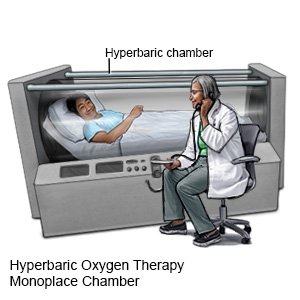
- Hyperbaric oxygen therapy: This is also called HBO. HBO is used to get more oxygen into your body. The oxygen is given under pressure to help it get into your tissues and blood. You may be put into a tube-like chamber called a hyperbaric or pressure chamber. You will be able to see your caregivers and talk with them through a speaker. You may need to have this therapy more than once.
- Intravenous therapy: This is a special liquid given to increase your blood pressure and remove harmful chemicals from your body. An intravenous (IV) tube is placed in your vein for giving medicine or liquids. This tube is capped or connected to tubing and liquid.
- Oxygen: You may need extra oxygen to help you breathe easier. It may be given through a plastic mask over your mouth and nose. It may be given through a nasal cannula, or prongs, instead of a mask. A nasal cannula is a pair of short, thin tubes that rest just inside your nose. Tell your caregiver if your nose gets dry or if the mask or prongs bother you. Ask your caregiver before taking off your oxygen. Never smoke or let anyone else smoke in the same room while your oxygen is on. Doing so may cause a fire.
Copyright © 2008 Thomson Healthcare Inc. All rights reserved. Information is for End User's use only and may not be sold, redistributed or otherwise used for commercial purposes.
The above information is an educational aid only. It is not intended as medical advice for individual conditions or treatments. Talk to your doctor, nurse or pharmacist before following any medical regimen to see if it is safe and effective for you.
| Link to Page | Print Page | Email Page |
