Thomson Reuters Micromedex

Breastfeeding And Nipple Soreness

What nipple problems may I have while breastfeeding?

Breastfeeding And Nipple Soreness Care Guide

Sore nipples are common for the first 1 to 2 weeks of breastfeeding. Your nipple and areola (the dark circle around your nipple) may look red and feel sore. After the first week of breastfeeding, this discomfort should decrease. It is never normal for your nipples to bruise or get blisters. Your nipples should not crack, scab, or bleed. It should not hurt to breastfeed. Learn the cause of your sore nipples so you can manage or prevent the pain. With care or treatment your nipples may heal. This may help you breastfeed longer and more comfortably.

Picture of a normal breast

What problems can cause nipple soreness?

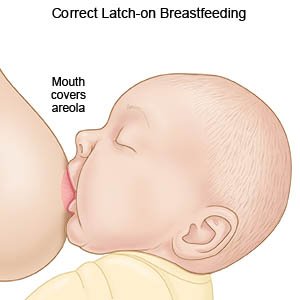
  • Latching on. Nipple soreness occurs when your baby is not latching on to your breast the right way. When your baby latches on, his chin and lower lip should touch your areola first. Then your baby’s upper lip takes most of the areola into his mouth. If it hurts when your baby latches on, take him off your breast and try again. When you have a good latch, you will soon hear your baby sucking slowly and deeply. Your nipples should have the same shape before and after each feeding.
    Correct Infant Latch-on Position


  • Positioning. Hold your baby so his ear, shoulder, and hip are in a straight line while he feeds. This position helps your baby latch on correctly.

  • Engorgement. When your milk comes in, or if you wait too long between feedings, engorgement can occur. Your breasts will look shiny and feel hard and painful. Your areolas and nipples may be so swollen that your baby cannot latch on correctly. Express some milk before feeding to help your baby latch on. Feed your baby or express your milk often to help prevent engorgement, reduced milk supply, and breast infections.

What conditions can lead to nipple soreness?

Talk with your caregiver about the following:

  • Flat or inverted nipples. The shape of your nipples may make it hard for your baby to get milk. Put cold compresses on your breasts, or pull or roll your nipples before a feeding to help your baby latch on.

  • Problems with your baby’s tongue or neck. Your baby needs to open his mouth wide and stick out his tongue to breastfeed well. If he was born with a condition called tongue-tie, it is hard for him to stick out his tongue. He may take long pauses between sucks, choke, cry, or fall asleep while feeding. A baby with torticollis has problems moving his head and neck away from one shoulder. This condition can also cause feeding problems.

  • Blood vessel spasms. Exposing your breasts to cold may cause burning or sharp, shooting pain in your nipples. Your nipples may turn pale (white), red, or purple. Place a heating pad or warm, wet cloth over your breasts to help decrease your pain. Do not smoke, and avoid cold, stress and caffeine to help prevent these symptoms. Caffeine may be found in coffee, sports drinks, and other drinks and foods.

  • Skin conditions and infections. Your nipples may look red and feel itchy and sore if you have dermatitis or psoriasis. A fungal infection called thrush can spread to your breast from your baby's mouth. Thrush causes nipples to look red, shiny, and flaky. You may feel burning or stabbing pain in your breasts. Blocked pores or ducts in your breast can lead to an infection that causes nipple pain. If you breastfeed less often because of sore nipples, blocked ducts can lead to a breast infection called mastitis. Mastitis causes flu-like symptoms.

How can nipple soreness affect breastfeeding?

You may feel tense if it hurts to breastfeed. This tense feeling may prevent milk from traveling to your nipple (milk let-down). If your baby needs to suck harder to get milk, this can make your nipple pain worse. Do not wait to get help if your nipples are cracked, sore, and painful. You may want to stop breastfeeding when you have sore nipples. Caregivers suggest breastfeeding for at least six months. Talk with your caregiver if you want to stop breastfeeding your baby.

How should I care for my nipples to prevent soreness?

  • Keep your nipples clean and dry.

  • Break the suction gently. Ask your caregiver to show you how to release your baby from your breast. Break the suction gently to help protect your nipple and areola.

  • Feed your baby when he is hungry. Crying is a late sign of your baby’s hunger. Breastfed infants feed 8 to 12 times each day. Watch and listen to your baby to learn when he wants to breastfeed. You may hear sucking, cooing, or sighing sounds. He may seem restless, and may suck on his hands and fingers. Breastfeeding your baby often can help prevent engorgement and sore nipples.

  • Talk with a caregiver about your breast pump. Nipple swelling can cause pain when you use a breast pump.

What can I do to feel better if I have nipple soreness?

Ask your caregiver about the following:

  • Try other ways to hold your baby during feedings. Caregivers can help you guide your baby to a correct latch. They can also show you ways to make breastfeeding easier for you by supporting and positioning your baby well.

  • Warm water compresses, tea bags, or expressed breast milk placed on your nipples may offer relief.

  • An ointment your caregiver suggests, such as lanolin, may prevent nipple dryness and scabbing. Ask your caregiver about ointments or dressings as treatment options for damaged nipples.

  • An over-the-counter pain reliever, such as ibuprofen, may help you feel better.

  • Take all of your medicines exactly as ordered. If you are taking antibiotics (germ-killing medicine) to treat an infection, take the medicine until it is gone, even if you start to feel better.

  • A breast pump can be used to express your milk until your nipples heal, if breastfeeding is too painful.

What should I know about having a pierced nipple and breastfeeding?

  • Remove your jewelry before breastfeeding. Nipple jewelry is dangerous for a breastfeeding baby. Your baby may swallow your jewelry or hurt his mouth or lips on it. When you take your jewelry out, it is normal for milk to squirt from the piercing in your nipple. The hole may close in a few weeks if you do not replace your jewelry after feedings.

  • If you must leave jewelry in your nipple, tighten or change it. Tighten each part of your jewelry before you breastfeed. The suction your baby creates while breastfeeding may be painful with some kinds of nipple jewelry. Use plastic barbells instead of metal jewelry. This may help your baby latch on, and prevent the piercing from closing. Tell caregivers if your pierced nipple hurts while breastfeeding.

  • Do not get a new piercing or tattoo while breastfeeding.

When should I schedule a follow-up visit with my caregiver?

Ask your caregiver when to return for a follow-up visit. Keep all appointments. Write down any questions you may have. This way you will remember to ask these questions during your next visit. Contact a lactation consultant. This is a caregiver who can help you with breastfeeding. You might also want to join a breastfeeding support group.

Where can I get more information?

For more information about breastfeeding, contact:

  • American Academy of Pediatrics
    141 Northwest Point Boulevard
    Elk Grove Village , IL 60007-1098
    Phone: 1- 847 - 434-4000
    Web Address: http://www.aap.org

When should I call my caregiver?

Call your caregiver if:

  • You have a fever (increased body temperature).

  • You see or feel a lump in your breast. The lump may be tender (painful when touched).

  • You have burning pain in one or both of your nipples that shoots into your breast.

  • You have nipple pain while feeding or between feedings. Your nipples may be red, dry, cracked, and bleeding. They may have scabs on them.

  • One or both of your breasts is red, swollen or hard, painful, and feels warm or hot.

  • Your nipple has thick yellow fluid (pus) coming out of it.

  • Your nipple and areola are painful, and you want to stop breastfeeding.

  • One or both of your breasts is swollen or painful and keeps you from breastfeeding.

Care Agreement

You have the right to choose how you feed your baby. To help with this plan, you must learn as much as you can about breastfeeding. Ask your caregiver for more information, or join a group with other breastfeeding mothers. You and your caregiver can work together to plan the best way to feed your baby.

Copyright © 2012. Thomson Reuters. All rights reserved. Information is for End User's use only and may not be sold, redistributed or otherwise used for commercial purposes.

The above information is an educational aid only. It is not intended as medical advice for individual conditions or treatments. Talk to your doctor, nurse or pharmacist before following any medical regimen to see if it is safe and effective for you.

Learn more about Breastfeeding And Nipple Soreness

Advertisement
Close

Recommended

(web1)