Breast Care For The Breast Feeding Mother
Why is breast care important while breastfeeding?
Breast Care For The Breast Feeding Mother Care Guide
- Breast Care For The Breast Feeding Mother
- Breast Care For The Breast Feeding Mother Aftercare Instructions
- Breast Care For The Breast Feeding Mother Discharge Care
- En Espanol
Experts suggest that a woman breastfeed a newborn infant for his first six months of life, without giving other liquids or food. You should keep on breastfeeding after 6 months, even while having your baby try other foods and drinks. Your breast milk gives your baby all of the liquids and nutrition that he needs to grow and develop. Breastfeeding your baby is healthy for you and your baby, now and in the future. Breast and nipple problems and certain conditions can make a woman not want to breastfeed as long as experts suggest. Caring for your breasts while breastfeeding your baby can help both you and your baby enjoy the benefits of breastfeeding.
What breast changes happen when breastfeeding a baby?
- If possible, you should start breastfeeding right after your baby is born. The feel of your baby’s skin against your skin helps your body release a hormone (body chemical) called oxytocin. This hormone helps your breasts release milk. This is also called milk let-down. For the first four days after your baby is born, a small amount of breast milk, called colostrum, is made by your body. At first, you may need to massage your breasts and try to express milk into your baby’s mouth while he tries to breastfeed. If your breasts feel soft right after having your baby, you may think that you are not making enough milk. Within days after your baby‘s birth, your breasts often look and feel fuller.

- Your body will begin making a larger amount of milk, called mature milk, within a few days of breastfeeding. When your mature milk comes in, your breasts will feel full and warm. They also may feel tender. These feelings are normal. Breastfeeding your baby will decrease the full feeling in your breasts. You may feel a let-down reflex one or more times during feedings as milk is released from your breasts. After about ten days, you will make only mature milk.
- After seven or more days, the fullness may feel like it has decreased. Your breasts should feel large, firm, and heavy. Your nipples should look the same as they did before starting breastfeeding. Breasts that feel full before and emptier after breastfeeding are a sign that breastfeeding is going well. Many women think they are not making enough milk for their baby, but this is usually not true. Your milk may not come in as fast as expected. Having trouble during labor and delivery of your baby, being obese, or having diabetes can cause your milk to come in later than expected. Flat or inverted nipples also may cause your milk to come in later than expected.
When might I not be able to breastfeed?
Ask your caregiver if it is safe for you to breastfeed if:
- You have an active tuberculosis infection that has not been treated. Talk with your caregiver before breastfeeding if you have started treatment for an active tuberculosis infection. Also talk with your caregiver before breastfeeding if you have been treated for a tuberculosis infection in the past .
- You are positive for human immunodeficiency virus (HIV). If you are HIV-positive, you may avoid breastfeeding to decrease the risk of passing the virus to your baby through your breast milk. Ask your caregiver before breastfeeding your baby.
- You are being treated for cancer or another medical condition. If you are having treatments for cancer or certain medical conditions, the substances used in your treatment may harm your breastfed baby. These substances include antimetabolites, radioactive isotopes, and chemotherapy medicine. You may need to wait for a certain time after treatment before breastfeeding your baby. If you are taking medicine or getting treatments that can harm your breastfed baby, you may need to add bottle-feeding. If you have questions about receiving these treatments while breastfeeding, talk to your caregiver.
- You drink too much alcohol, or drink it too often. Alcohol is found in adult drinks such as beer, wine, and whiskey. If you drink alcohol often, or in large amounts, you may not be able to breastfeed. Talk to your caregiver if your drink alcohol.
- You use illegal drugs. If you use illegal (street) drugs, also called drugs of abuse, you may not be able to breastfeed. Street drugs include heroin, cocaine, methamphetamine, and others.
- You have herpes simplex. If you have a disease called herpes simplex and you have sores on your breasts, you may not be able to breastfeed. See your caregiver if you have breast lesions (sores), and ask him about breastfeeding.
- You have varicella. Varicella is the virus that causes chickenpox. If you have the chickenpox rash, it can spread to your baby. You may need to use a breast pump or express milk to feed your baby until the rash can no longer spread. If your baby already has the rash, you and your baby may need to stay away from others, but you may still be able to breastfeed. Ask your caregiver for more information about varicella.
What breast problems can occur while breastfeeding?
- Nipple soreness:
- Many women have painful nipples when they begin to breastfeed a baby. A small amount of nipple pain is normal. Repositioning your baby and helping him latch on to your breast correctly may decrease or stop the pain in your nipples.
- Breast infections, skin conditions, and certain diseases can cause nipple soreness. Your nipples can become painful and swollen when you use a breast pump to collect your breast milk. Changes in your hormones can also cause nipple soreness. Infant problems such as tongue-tie can affect the way your baby latches on to your breast. This can cause sore nipples. Work with your caregiver to help your baby latch on correctly so he gets the milk that he needs.
- Do not use nipple creams, ointments, or any other medicine or devices on your breasts or nipples unless your caregiver tells you to. Do not use a new kind of soap to wash your bra. Placing warm, wet compresses, tea bags, or breast milk on your nipples may help decrease pain. Ask your caregiver for more information about breastfeeding and nipple soreness.
- Many women have painful nipples when they begin to breastfeed a baby. A small amount of nipple pain is normal. Repositioning your baby and helping him latch on to your breast correctly may decrease or stop the pain in your nipples.
- Engorgement:
- Your breasts may grow swollen and painful as your milk comes in soon after you begin breastfeeding. This is called engorgement. Feeding your baby often and emptying your breasts is the best way to decrease engorgement symptoms. Feeding your baby when he shows signs of being hungry instead of feeding him on a set schedule can help prevent engorgement. Massaging your breasts or expressing some milk by hand may decrease your discomfort.
- Engorgement can make it hard for your baby to latch on to your breast. If this happens, express a small amount of milk, and then have your baby latch on. Your caregiver may suggest medicine to decrease pain or swelling. Cabbage leaves placed on your breasts may also decrease your symptoms. Cold compresses or gel packs may help you feel better. Breast redness, pain, and a fever (high body temperature) are signs that engorgement is getting worse. If engorgement worsens and is not treated, your baby may not get enough milk, and your nipples may be damaged.
- Your breasts may grow swollen and painful as your milk comes in soon after you begin breastfeeding. This is called engorgement. Feeding your baby often and emptying your breasts is the best way to decrease engorgement symptoms. Feeding your baby when he shows signs of being hungry instead of feeding him on a set schedule can help prevent engorgement. Massaging your breasts or expressing some milk by hand may decrease your discomfort.
- Plugged milk ducts: Plugged ducts cause painful breast lumps. Plugged ducts can be caused by not emptying your breasts fully. To prevent plugged ducts, empty your breasts through breastfeeding or using a breast pump at each feeding. Do not wear underwire bras or tight clothing over your breasts. Find ways to manage stress, and try to get enough sleep. Drink plenty of fluids. Ask your caregiver about diet changes that can decrease your risk of getting plugged milk ducts. Changes may include avoiding high-fat dairy products or adding a diet supplement. To help avoid plugged ducts as you are weaning your baby, slowly increase the time between feedings. You can stop breastfeeding and begin using a breast pump to drain your breasts instead. Feed breast milk to your baby using a bottle or a cup. Slowly increase the time between pumping your breasts.
- Breast infections:
- Having plugged ducts or not emptying your breasts can lead to a breast infection called mastitis. With mastitis, your breasts grow red, swollen, and painful. Treatment includes emptying your breasts fully and often by breastfeeding or using a breast pump. When your baby pauses while breastfeeding, massage and gently squeeze your breast. Gentle massage may unplug a blocked milk duct. Pump out the milk left in your breasts after your baby is done breastfeeding. Ask your caregiver about feeding your baby when you have a breast infection.
- Using heat on your breasts may decrease the pain. You may want to place a moist, warm cloth on the painful breast or both of your breasts. Ask your caregiver how often to do this. Your caregiver may suggest anti-inflammatory medicine to decrease pain and swelling. Your caregiver may order antibiotics (germ-killing medicine) to treat mastitis. Getting enough rest and sleep and drinking more liquids can also help. If the mastitis is not treated, you may get flu-like symptoms, such as a fever and chills. Mastitis can lead to a serious infection called cellulitis, or can lead to a breast abscess (pus pocket).
- Having plugged ducts or not emptying your breasts can lead to a breast infection called mastitis. With mastitis, your breasts grow red, swollen, and painful. Treatment includes emptying your breasts fully and often by breastfeeding or using a breast pump. When your baby pauses while breastfeeding, massage and gently squeeze your breast. Gentle massage may unplug a blocked milk duct. Pump out the milk left in your breasts after your baby is done breastfeeding. Ask your caregiver about feeding your baby when you have a breast infection.
What can I do to help prevent or manage breast problems and conditions while breastfeeding?
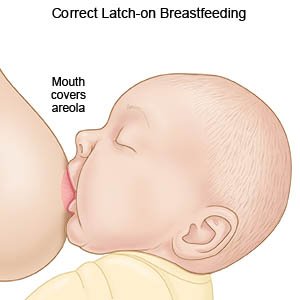
- Work with your caregiver to learn how your baby should be latched on to your breast, and how to hold him while he is breastfeeding. If your baby is attached correctly, he will pull your breast deep in his mouth. He will not be attached only to the nipple. Your baby is latched on well if you feel comfortable, your nipples and breasts are not painful, and your nipple is the same shape as it was after breastfeeding.
- Take your medicine as ordered by your caregiver. Tell your caregiver about all of the medicines, herbs, and supplements that you use.
- Talk to your caregiver about breast exams and tests. Your risk of getting breast cancer decreases if you breastfeed. Mammograms and other breast cancer screening exams and tests can be done even if you are breastfeeding your baby. Ask your caregiver for more information, and when and how often to have these exams and tests.
- Talk to your caregiver if you drink alcohol. If you choose to drink alcohol, breastfeed your baby before you drink it. Do not breastfeed your baby for at least 2 to 2 ½ hours after having one drink. One drink of alcohol is 12 ounces of beer or four ounces of wine. One ounce of liquor, such as whiskey, is one drink of alcohol. Talk to your caregiver if you drink alcohol and are breastfeeding.
- Stop smoking. It is never too late to quit smoking. Smoking harms your body in many ways. You are more likely to have heart disease, lung disease, cancer, and other health problems if you smoke. Quitting smoking will improve your health and the health of those around you. If you smoke, avoid smoking while breastfeeding. Smoking can decrease your milk supply. Do not let anyone smoke around your child. Your child is more likely to get certain types of infections if he breathes in cigarette smoke. Being around cigarette smoke can also affect your child’s lungs and cause breathing problems.
- Schedule and attend all follow-up visits with caregivers. When you take your baby to a visit with his caregiver, or you see your caregiver, talk about breastfeeding problems that you are having. Caregivers may suggest that you, or you and your partner, attend classes on breastfeeding. You also may want to attend a breastfeeding support group. Ask caregivers for information about where to rent a breast pump, and if you should see a lactation consultant. This is a caregiver who can teach you more about breastfeeding. Ask your caregiver when and how often to schedule follow-up visits for yourself and your baby.
- Eat a healthy diet. Eat a variety of healthy foods from all the food groups every day. Ask your caregiver for more information on breastfeeding and your diet.
- Prevent biting. When your baby gets teeth, which might be at about 3 to 4 months of age, you may worry that he will bite you while breastfeeding. To help avoid biting, do the following:
- When your baby is finished draining your breast during a feeding, do not let him keep sucking. Take him off of your breast once he's finished or if he has fallen asleep.
- If your older baby bites you, respond with surprise or unhappiness. Offer praise when he does not bite you.
- When your baby is finished draining your breast during a feeding, do not let him keep sucking. Take him off of your breast once he's finished or if he has fallen asleep.
What should I know about ways to prevent breast problems as I feed my baby?
- Hold your baby correctly and make sure he has a good latch-on when breastfeeding. This helps ensure that he gets enough milk, and helps prevent sore nipples and other breast problems. If you have flat or inverted nipples, ask caregivers for help to position and help your baby latch on to breastfeed. Breast surgery and problems with breast development can affect how much milk your breasts can make. Work with your caregiver to ensure that your baby is getting enough breast milk during feedings.
- Feed your baby 8 to 12 times a day. You may need to wake your baby up at night to feed him. It is okay to feed from one or from both breasts at each feeding. Your baby should breastfeed from both breasts equally over the course of a day. If your baby only feeds from one side during a feeding, offer your other breast to him first for the next feeding. Fully draining your breasts by breastfeeding and using a breast pump at each feeding helps your body make more milk. Signs that your baby is getting enough milk at a feeding are softer, leaking breasts.
What should I know about breastfeeding and contraception?
- Breastfeeding delays the return of monthly menstrual periods after having a baby. Not having a monthly menstrual period makes it less likely that you will get pregnant, but it is still possible. If you do not want to get pregnant right away, do not wait until your periods begin again to start using contraception. Contraceptive methods are ways to help prevent pregnancy. Some methods are intrauterine devices (IUD), condoms and spermicides, female or male sterilization, birth control medicine, and the lactation amenorrhea method (LAM). With LAM, your risk of getting pregnant is low if you are within the first six months of giving birth and your periods have not returned. For LAM to help prevent pregnancy, you must be breastfeeding your baby only, without using infant formula.
- Some methods of contraception can be started right after or very soon after having a baby. Other methods must be started later. When deciding on a method of contraception, talk to your caregiver about your thoughts and feelings. Also talk about your plans, such as returning to work. Tell caregivers about your breastfeeding and sexual activity patterns. To prevent pregnancy, you must remember to use the method that you select, and to always use it correctly. After selecting and starting a method, see your caregiver and tell him about any side effects or problems. Tell him if you want to use a different contraceptive method. Ask your caregiver for more information about contraceptive methods that may work for you.
When should I call my caregiver?
Call your caregiver if:
- One or both of your breasts is red, swollen or hard, painful, and feels warm or hot.
- Your symptoms, such as breast pain and swelling, are getting worse, even with treatment.
- Your signs and symptoms of engorgement are not getting better within 24 hours.
- You see or feel a lump in your breast. The lump may be tender (painful when touched).
- You have nipple pain while feeding or between feedings. Your nipples may look red, dry, and cracked or bleeding. They may have scabs on them.
- You feel you are not making enough breast milk for your baby.
- Your milk has not come in within five days of giving birth. Your milk has come in if your breasts feel full or swollen. Your breasts may also be leaking milk.
Care Agreement
You have the right to help plan your care. To help with this plan, you must learn as much as you can about breastfeeding. Ask your caregiver questions about breast care. Work with him to decide what care is best for you and your baby.
Copyright © 2012. Thomson Reuters. All rights reserved. Information is for End User's use only and may not be sold, redistributed or otherwise used for commercial purposes.
The above information is an educational aid only. It is not intended as medical advice for individual conditions or treatments. Talk to your doctor, nurse or pharmacist before following any medical regimen to see if it is safe and effective for you.