
Bicycle Safety
Medically reviewed by Drugs.com. Last updated on Aug 4, 2025.
Bicycle safety includes choosing the right bicycle and following safety rules to prevent injury.
DISCHARGE INSTRUCTIONS:
Return to the emergency department if:
- Your child hit his or her head or face during a bicycle accident.
- Your child may have broken bones caused by a bicycle accident.
- Your child vomits or coughs up blood after a bicycle accident.
Contact your healthcare provider if:
- You have questions or concerns about bicycle safety.
What you need to know before you buy a bicycle for your child:
- Make sure the bicycle is the right size. Your child should be able to stand on flat feet with one leg on each side of the bicycle. A gap of 1 to 3 inches should be between your child and the top bar. He or she should be able to hold the handlebars without having to lean forward. He or she should also be able to hold the hand brakes.
- Buy a helmet that fits. A helmet helps protect your child from a head or face injury. Check inside the helmet for a sticker or label stating that the helmet meets safety standards. The helmet should be approved by the United States Consumer Products Safety Commission (CPSC). Buy a light-colored helmet with a reflective sticker on the back. This will make it easier for other drivers to see your child.
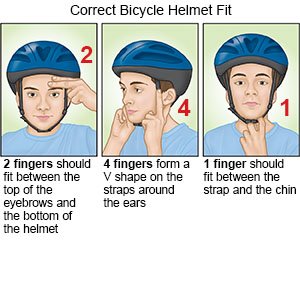
- Get the right equipment. The bicycle should have reflectors, a horn or bell, a side-view mirror, and head and tail lights. Your child's bicycle may need training wheels until he or she learns to keep his or her balance.
Check the following before you let your child ride a bicycle:
- Check that the brakes work properly and the tires have the proper amount of air.
- Check that the bicycle has reflectors and that the lights are working. Lights and reflectors will help drivers and other people see your child on the bicycle.
- Check and repair any loose or damaged parts on the bicycle before your child rides it.
Bicycle safety rules to teach your child:
The following should be rules your child must follow when he or she rides a bicycle:
- Always wears a helmet. Teach your child to wear a helmet every time he or she rides a bicycle, even on short trips.
- Wear bright, protective clothing and gear. Elbow and knee pads can help prevent injury. A reflective vest will help your child be seen when he or she rides a bicycle in the dark. Bright clothing will help him or her be seen during the day.
- Follow traffic rules. Teach your child to ride with the flow of traffic. Teach your child to use hand signals before he or she makes a turn or stops. Tell him or her not to ride in high-traffic areas. He or she should ride on lanes provided for bicycles whenever possible.
- Do not allow anyone to ride on the handlebars or seat. The weight of an extra person may make the bicycle hard to control. Also tell your child not to ride on the handlebars or seat of another person, including an adult. He or she should be secured in a seat or carrier made to carry children as passengers on bicycles.
- Be aware of your surroundings. Teach your child to look for obstacles in his or her path. He or she should be aware of the people and traffic around him or her. Tell your child not to ride too closely to parked cars. He or she may run into a door if it opens suddenly. Tell your child not listen to music while he or she rides. He or she may not hear cars nearby.
- Cross the street in a crosswalk. Teach your child not to cross in between parked cars. Tell him or her to walk the bicycle across the street.
Follow up with your child's healthcare provider as directed:
Write down your questions so you remember to ask them during your visits.
For more information:
- National Highway Traffic Safety Administration
1200 New Jersey Avenue, SE
Washington , DC 20590
Phone: 1- 888 - 327-4236
Web Address: http://www.nhtsa.dot.gov
- American Academy of Family Physicians
11400 Tomahawk Creek Parkway
Leawood , KS 66211-2680
Phone: 1- 913 - 906-6000
Phone: 1- 800 - 274-2237
Web Address: http://www.aafp.org
© Copyright Merative 2025 Information is for End User's use only and may not be sold, redistributed or otherwise used for commercial purposes.
The above information is an educational aid only. It is not intended as medical advice for individual conditions or treatments. Talk to your doctor, nurse or pharmacist before following any medical regimen to see if it is safe and effective for you.
Further information
Always consult your healthcare provider to ensure the information displayed on this page applies to your personal circumstances.