Autosomal Dominant Polycystic Kidney Disease
WHAT YOU SHOULD KNOW:
Autosomal Dominant Polycystic Kidney Disease (Discharge Care) Care Guide
- Autosomal Dominant Polycystic Kidney Disease
- Autosomal Dominant Polycystic Kidney Disease Aftercare Instructions
- Autosomal Dominant Polycystic Kidney Disease Discharge Care
- Autosomal Dominant Polycystic Kidney Disease Inpatient Care
- En Espanol
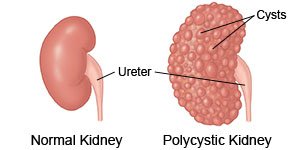
- Autosomal dominant polycystic kidney disease (ADPKD) is a condition in which many cysts grow in your kidneys. Cysts are abnormal growths which may contain fluid. ADPKD is most often caused by damaged genes that were passed on to you by a parent. Genes are little pieces of information which tell cells how to grow and what to do. ADPKD cysts may become large and damage your kidneys. The damage may lead to kidney failure. With kidney failure, harmful wastes and fluids may build up in your body. Signs and symptoms of ADPKD may include pain in your back or sides, headaches, kidney stones, and blood-colored urine. You may also have cysts in other organs such as your liver and pancreas.

- Imaging tests may help your caregiver learn if you have ADPKD. These may include a computed tomography (CT) scan, an ultrasound, or magnetic resonance imaging (MRI). There is no cure for ADPKD. You may be given medicines to treat your pain, high blood pressure, and other symptoms. Having your ADPKD treated may help prevent the build up of harmful wastes and fluids in your body. Treatment may slow the rate of your kidney failure. Treatment for ADPKD may improve your symptoms and prolong your life.
AFTER YOU LEAVE:
Take your medicine as directed.
Call your primary healthcare provider if you think your medicine is not helping or if you have side effects. Tell him if you are allergic to any medicine. Keep a list of the medicines, vitamins, and herbs you take. Include the amounts, and when and why you take them. Bring the list or the pill bottles to follow-up visits. Carry your medicine list with you in case of an emergency.
- Antibiotics: This medicine is given to help treat or prevent an infection caused by bacteria.
- Blood pressure medicine: This is given to lower your blood pressure. A controlled blood pressure helps protect your organs, such as your heart, lungs, brain, and kidneys. Take your blood pressure medicine exactly as directed.
- Cholesterol medicine: This type of medicine is given to help decrease (lower) the amount of cholesterol (fat) in your blood.
- Pain medicine: You may need medicine to take away or decrease pain.
- Learn how to take your medicine. Ask what medicine and how much you should take. Be sure you know how, when, and how often to take it.
- Do not wait until the pain is severe before you take your medicine. Tell caregivers if your pain does not decrease.
- Pain medicine can make you dizzy or sleepy. Prevent falls by calling someone when you get out of bed or if you need help.
- Learn how to take your medicine. Ask what medicine and how much you should take. Be sure you know how, when, and how often to take it.
- Nonsteroidal anti-inflammatory (NSAID) medicine may decrease swelling and pain or fever. This medicine can be bought with or without a doctor's order. This medicine can cause stomach bleeding or kidney problems in certain people. If you take blood thinner medicine, always ask your primary healthcare provider if NSAIDs are safe for you. Always read the medicine label and follow the directions on it before using this medicine.
Ask for information about where and when to go for follow-up visits:
For continuing care, treatments, or home services, ask for more information.
Diet:
You may need to avoid salty foods. Salty foods may cause your blood pressure to increase. Try to decrease the amount of protein you eat. Proteins are processed in your kidneys. If you have poor kidney function, it may be hard for your kidneys to break down the protein. Foods that are high in protein are meat, poultry (chicken), fish, eggs, and dairy products (milk, cheese, and yogurt). Your caregiver will tell you how much protein you should eat each day. Ask your caregiver if you have questions or concerns about your diet.
Genetic counseling
During genetic counseling, you and your family will learn about genetic diseases. This information may help you and your family make important decisions, such as planning a family.
For support and more information:
Accepting that you have ADPKD may be hard. You and those close to you may feel angry, scared, or sad. These feelings are normal. Talk to your caregiver, family members, and friends about your feelings. You may also want to join a support group. This is a group of people who also have ADPKD. You may contact the following:
- American Association of Kidney Patients
3505 E. Frontage Rd, Suite 315
Tampa , FL 33607-1796
Phone: 1- 800 - 749-2257
Web Address: http://aakp.org
- National Kidney Foundation
30 East 33rd Street
New York , NY 10016
Phone: 1- 212 - 889-2210
Phone: 1- 800 - 622-9010
Web Address: http://www.kidney.org
CONTACT A CAREGIVER IF:
- You are female and know or think you are pregnant. Being pregnant and having ADPKD may cause a birth defect on your unborn child.
- You have a bitter taste in your mouth or early satiety. Early satiety is feeling full after eating less than usual.
- You have a decreased appetite for food and are unable to eat or drink.
- You have a fever.
- You have pain in your back, sides, or abdomen even with medicines.
- You have pain when you urinate.
- You have questions or concerns with your disease or treatment.
SEEK CARE IMMEDIATELY IF:
- You have a very bad headache or you have headaches that come and go often.
- You have blood in your urine.
- You have chest pain or trouble breathing.
- You have facial swelling or your whole body becomes swollen.
- You have pain in your abdomen.
- You have yellowing of your eyes or skin.
- You have signs of a stroke: The following signs are an emergency. Call 911 immediately if you have any of the following:
- Weakness or numbness in your arm, leg, or face (may be on only one side of your body)
- Confusion and problems speaking or understanding speech
- A very bad headache that may feel like the worst headache of your life
- Not being able to see out of one or both of your eyes
- Feeling too dizzy to stand
- Weakness or numbness in your arm, leg, or face (may be on only one side of your body)
© 2013 Truven Health Analytics Inc. Information is for End User's use only and may not be sold, redistributed or otherwise used for commercial purposes. All illustrations and images included in CareNotes® are the copyrighted property of the Blausen Databases or Truven Health Analytics.
The above information is an educational aid only. It is not intended as medical advice for individual conditions or treatments. Talk to your doctor, nurse or pharmacist before following any medical regimen to see if it is safe and effective for you.
Learn more about Autosomal Dominant Polycystic Kidney Disease (Discharge Care)
Micromedex Care Notes:
Related encyclopedia articles:
Symptoms and treatment for: