Amblyopia In Children
GENERAL INFORMATION:
What is amblyopia?
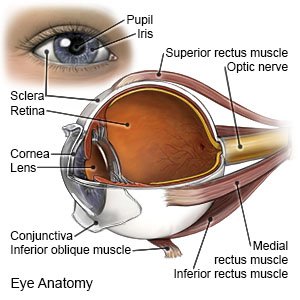
- Amblyopia (am-ble-O-pe-ah), also called lazy eye, is a condition where your child cannot see details very well. In the normal eye, light enters and is focused by the lens on the retina. The lens is a clear disc in your child's eye that focuses light to a single point to help him see clearly. The retina transforms the light into electrical signals which are sent to your child's brain. The brain then uses these signals and tells your child what he sees.

- As your child uses both eyes to see, the visual system of his brain is stimulated and develops quickly. Amblyopia happens when there is a lack of stimulation coming from one or both eyes resulting in a poorly developed visual system. The brain may favor one eye instead of both eyes, and this may cause problems in transforming the signals into images.
What are the causes of amblyopia? When conditions affect your child's ability to see clearly, the brain's visual system has a hard time developing. When the visual system is poorly developed, your child may have trouble seeing and understanding what he sees. The following conditions may affect the visual system as your child is growing up and cause amblyopia:
- Cataract: This is a condition where your child's lens gets cloudy and blocks some or all of the light entering his eye. This may cause your child to see dark or hazy images.
- Strabismus: Normally, both eyes should move together and look at the same thing at the same time. This is a condition where your child's eye is not moving together with the other eye. This may cause your child to see double.
- Error of refraction: This is a condition where the lens of your child's eye is not focusing light waves very well. He may see the image as blurry and unclear. This condition may occur in one or both eyes of your child. When both eyes have different errors of refraction from each other, he may have a condition called anisometropia.
What are the signs and symptoms of amblyopia? Your child may have any of the following:
- Eyes may not be aligned, or not move together at the same time
- Not see things properly or not see objects waved in front of him.
- One eye may drift and look away from the object in front of him.
- Tilts his head to one side to see an object better.
How is amblyopia diagnosed? Your caregiver will take a complete medical history and do a physical examination. Your caregiver may ask you if your child's head is tilting to one side when he is looking at things. He may ask if you notice your child's eyes are not aligned or moving together at the same time. Your caregiver may also use lenses and other instruments to examine your child's eyes to see any problems. Your child may have amblyopia when his ability to see clearly is decreased. Your child may need any of the following tests:
- Corneal light reflex test: This test uses light to see if your child's eyes are aligned, or looking at the same thing at the same time. A light is shined near your child's eyes. Your child's caregiver looks at the reflection on your child's eyes. Normally, the reflections should be at the same distance from his nose. If the reflections are not even, one of your child's eyes is not aligned.
- Cover-uncover test: This also checks if your child's eyes are aligned. An object is placed farther down the room and your child's caregiver covers your child's eye. He carefully looks at the uncovered eye for any movement. If the uncovered eye moves to look at the object, he may have amblyopia.
- Test for fixation: This is used for children who cannot speak yet. In this test, your child's caregiver covers your child's eye. He waves a small flashlight in front of your child and sees how well he follows the light. He repeats the test on the other eye and compares the results.
- Visual acuity test: This test uses charts with letters, pictures, and shapes to check how well your child can see. Your child is seated, and he is asked what he sees on the chart placed farther down the room. There are special charts that can be used for children who cannot read or speak yet. Your child's caregiver tests visual acuity by looking at your child's reactions when he holds up objects or charts.
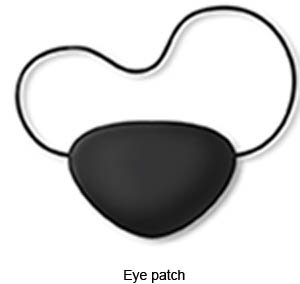
How is amblyopia treated? Problems that affect your child's visual acuity first have to be corrected. Your child may have to wear eyeglasses, or have surgery to improve visual acuity. This allows the poorly developed visual system of the affected eye to properly see objects, and develop and function normally. Your child's caregiver will then block the good eye to let the affected eye's visual cortex develop and catch up. He may ask your child to wear an eyepatch over the normal eye at certain times of the day. Your child's caregiver may suggest contact lens, eyeglasses, or put medicine to blur vision in the good eye. These let the affected eye see by itself and let its visual system develop along with the good eye's visual system. Your child's caregiver will do regular checkups to check the condition of both eyes.
Where can I get more information? Having a child with amblyopia may be hard for you and your child. You, your child, and your family may feel frustrated, angry, and sad because of his condition. You may even blame yourself for his condition. These are normal feelings. Contact the following for more information:
- American Academy of Ophthalmology
7424
San Francisco, CA 941207424
Phone: 1-415-5618500
Web Address: http://www.aao.org/
- National Eye Institute, National Institutes of Health
202 Vision Pl.
Bethesda, MD 20892-3655
Phone: 1-301-496-5248
Web Address: www.nei.nih.gov
- Prevent Blindness America
211 W. Wacker Dr, Ste 1700
Chicago, IL 60606
Phone: 1-800-331-2020
Web Address: www.preventblindness.org
CARE AGREEMENT:
You have the right to help plan your child's care. To help with this plan, you must learn about your child's health condition and how it may be treated. You can then discuss treatment options with your child's caregivers. Work with them to decide what care may be used to treat your child.
Copyright © 2008 Thomson Healthcare Inc. All rights reserved. Information is for End User's use only and may not be sold, redistributed or otherwise used for commercial purposes.
The above information is an educational aid only. It is not intended as medical advice for individual conditions or treatments. Talk to your doctor, nurse or pharmacist before following any medical regimen to see if it is safe and effective for you.
| Link to Page | Print Page | Email Page |