
Humate-P Dosage
Generic name: HUMAN COAGULATION FACTOR VIII/VON WILLEBRAND FACTOR COMPLEX 80[iU] in 1mL;
Dosage form: injection
Drug class: Miscellaneous coagulation modifiers
Medically reviewed by Drugs.com. Last updated on Aug 7, 2023.
Therapy for Hemophilia A
One International Unit (IU) of Factor VIII (FVIII) activity per kg body weight will increase the circulating FVIII level by approximately 2.0 International Units (IU)/dL. Dosage must be individualized based on the patient's weight, type and severity of hemorrhage, FVIII level, and presence of inhibitors. Judge the adequacy of treatment by clinical effects and, in all cases, adjust doses as needed based on clinical judgment and on frequent monitoring of the patient's FVIII level. Table 1 provides dosing recommendations for the treatment of hemophilia A in adults.
| Hemorrhagic Event | Dosage (IU FVIII:C/kg Body Weight) |
|---|---|
| IU = International Units. | |
Minor hemorrhage:
|
Loading dose 15 IU FVIII:C/kg to achieve a FVIII:C plasma level of approximately 30% of normal; one infusion may be sufficient. If needed, half of the loading dose may be given once or twice daily for 1-2 days. |
Moderate hemorrhage:
|
Loading dose 25 IU FVIII:C/kg to achieve a FVIII:C plasma level of approximately 50% of normal, followed by 15 IU FVIII:C/kg every 8-12 hours for the first 1-2 days to maintain the FVIII:C plasma level at 30% of normal. Continue the same dose once or twice daily for up to 7 days or until adequate wound healing is achieved. |
Life-threatening hemorrhage:
|
Initially 40-50 IU FVIII:C/kg, followed by 20-25 IU FVIII:C/kg every 8 hours to maintain the FVIII:C plasma level at 80-100% of normal for 7 days. Continue the same dose once or twice daily for another 7 days to maintain the FVIII:C level at 30-50% of normal. |
Treatment of Bleeding Episodes in VWD
Administer 40 to 80 International Units (IU) VWF:RCo (corresponding to 17 to 33 International Units (IU) FVIII in HUMATE-P) per kg body weight every 8 to 12 hours. Adjust the dosage based on the extent and location of bleeding. Administer repeat doses as long as needed based on monitoring of appropriate clinical and laboratory measures [see Warnings and Precautions (5.2, 5.3)]. Expected levels of VWF:RCo are based on an expected in vivo recovery (IVR) of 2.0 International Units (IU)/dL rise per International Unit (IU)/kg VWF:RCo administered. The administration of 1 International Unit (IU) of FVIII per kg body weight can be expected to lead to a rise in circulating VWF:RCo of approximately 5 International Units (IU)/dL. Table 2 provides dosing recommendations for adult and pediatric patients [see Use in Specific Populations (8.4)].2
| VWD Type | Severity of Hemorrhage | Dosage (IU* VWF:RCo/kg Body Weight) |
|---|---|---|
| Type 1 VWD – Mild (baseline VWF:RCo activity typically >30%) |
Minor (e.g., epistaxis, oral bleeding, menorrhagia) |
Typically treatable with desmopressin. |
| Minor (when desmopressin is known or suspected to be inadequate) Major† (e.g., severe or refractory epistaxis, GI bleeding, CNS trauma, traumatic hemorrhage) |
Loading dose 40-60 IU/kg. Then 40-50 IU/kg every 8-12 hours for 3 days to keep the trough level of VWF:RCo >50%. Then 40-50 IU/kg daily for up to 7 days. |
|
| Type 1 VWD – Moderate or severe (baseline VWF:RCo typically <30%) | Minor (e.g., epistaxis, oral bleeding, menorrhagia) |
40-50 IU/kg (1 or 2 doses). |
| Major (e.g., severe or refractory epistaxis, GI bleeding, CNS trauma, hemarthrosis, traumatic hemorrhage) |
Loading dose 50-75 IU/kg. Then 40-60 IU/kg every 8-12 hours for 3 days to keep the trough level of VWF:RCo >50%. Then 40-60 IU/kg daily for up to 7 days. |
|
| Type 2 VWD (all variants) and Type 3 VWD | Minor (clinical indications above) |
40-50 IU/kg (1 or 2 doses). |
| Major (clinical indications above) |
Loading dose 60-80 IU/kg. Then 40-60 IU/kg every 8-12 hours for 3 days to keep the trough level of VWF:RCo >50%. Then 40-60 IU/kg daily for up to 7 days. |
|
Prevention of Excessive Bleeding During and After Surgery in VWD
The following information provides guidelines for calculating loading and maintenance doses of HUMATE-P for patients undergoing surgery. However in the case of emergency surgery, administer a loading dose of 50 to 60 International Units (IU) VWF:RCo/kg body weight and, subsequently, closely monitor the patient's trough coagulation factor levels.
Measure incremental IVR and assess plasma VWF:RCo and FVIII:C levels in all patients prior to surgery when possible.
To determine IVR:
- Measure the baseline plasma VWF:RCo level.
- Infuse a calculated dose [International Units (IU)/kg] of VWF:RCo product intravenously at "time 0".
- At "time+30 minutes", measure the plasma VWF:RCo level.
Use the following formula to calculate IVR:
IVR = (Plasma VWF:RCotime+30 min – Plasma VWF:RCobaseline International Units (IU)/dL)
Calculated dose (International Units (IU)/kg)
For example, assuming a baseline VWF:RCo of 30 International Units (IU)/dL at "time 0", a calculated dose of 60 International Units (IU)/kg, and a VWF:RCo of 120 International Units (IU)/dL at "time+30 minutes", the IVR would be 1.5 International Units (IU)/dL per International Units (IU)/kg of VWF:RCo administered.
Loading Dose
Table 3 provides guidelines for calculating the loading dose for adult and pediatric patients based on the target peak plasma VWF:RCo level, the baseline VWF:RCo level, body weight in kilograms, and IVR. When individual recovery values are not available, a standardized loading dose can be used based on an assumed VWF:RCo IVR of 2.0 International Units (IU)/dL per International Unit (IU)/kg of VWF:RCo administered.
| Type of Surgery | VWF:RCo Target Peak Plasma Level |
FVIII:C Target Peak Plasma Level |
Calculation of Loading Dose (to be administered 1 to 2 hours before surgery) |
|
|---|---|---|---|---|
| IU = International Units. BW = body weight. |
||||
|
||||
| Major | 100 IU/dL | 80-100 IU/dL | Δ* VWF:RCo × BW (kg) IVR† |
= IU VWF:RCo required |
| If the IVR is not available, assume an IVR of 2.0 IU/dL per IU/kg and calculate the loading dose as follows: (100 – baseline plasma VWF:RCo) × BW (kg)/2.0 |
||||
| Minor/Oral‡ | 50-60 IU/dL | 40-50 IU/dL | Δ* VWF:RCo × BW (kg) IVR |
= IU VWF:RCo required |
| Emergency | 100 IU/dL | 80-100 IU/dL | Administer a dose of 50-60 IU VWF:RCo/kg body weight. | |
For example, the loading dose of HUMATE-P required assuming a target VWF:RCo level of 100 International Units (IU)/dL, a baseline VWF:RCo level of 20 International Units (IU)/dL, an IVR of 2.0 International Units (IU)/dL per International Units (IU)/kg, and a body weight of 70 kg would be 2,800 International Units (IU) VWF:RCo, calculated as follows:
| IU = International Units. | |
| (100 IU/dL – 20 IU/dL) × 70 kg | = 2,800 IU VWF:RCo required |
| 2.0 (IU/dL)/(IU/kg) | |
Attaining a target peak FVIII:C plasma level of 80 to 100 International Units (IU) FVIII:C/dL for major surgery and 40 to 50 International Units (IU) FVIII:C/dL for minor surgery or oral surgery might require additional dosing with HUMATE-P. Because the ratio of VWF:RCo to FVIII:C activity in HUMATE-P is 2.4:1, any additional dosing will increase VWF:RCo proportionally more than FVIII:C. Assuming an incremental IVR of 2.0 International Units (IU) VWF:RCo/dL per International Units (IU)/kg infused, additional dosing to increase FVIII:C in plasma will also increase plasma VWF:RCo by approximately 5 International Units (IU)/dL for each International Unit (IU)/kg of FVIII administered.
Maintenance Doses
The initial maintenance dose of HUMATE-P for the prevention of excessive bleeding during and after surgery should be half of the loading dose, irrespective of additional dosing required to meet FVIII:C targets. Subsequent maintenance doses should be based on the patient's VWF:RCo and FVIII levels. Table 4 provides recommendations for target trough plasma levels (based on type of surgery and number of days following surgery) and minimum duration of treatment for subsequent maintenance doses. These recommendations apply to both adult and pediatric patients.
| Type of Surgery | VWF:RCo Target Trough Plasma Level* |
FVIII:C Target Trough Plasma Level* |
Minimum Duration of Treatment | ||
|---|---|---|---|---|---|
| Up to 3 days following surgery | After Day 3 | Up to 3 days following surgery | After Day 3 | ||
| IU = International Units. | |||||
|
|||||
| Major | >50 IU/dL | >30 IU/dL | >50 IU/dL | >30 IU/dL | 72 hours |
| Minor | ≥30 IU/dL | – | – | >30 IU/dL | 48 hours |
| Oral† | ≥30 IU/dL | – | – | >30 IU/dL | 8-12 hours‡ |
Based on individual pharmacokinetic-derived half-lives, the frequency of maintenance doses is generally every 8 or 12 hours; patients with shorter half-lives may require dosing every 6 hours. In the absence of pharmacokinetic data, it is recommended that HUMATE-P be administered initially every 8 hours with further adjustments determined by monitoring trough coagulation factor levels. When hemostatic levels are judged insufficient or trough levels are outside the recommended range, consider modifying the administration interval and/or the dose.
It is advisable to monitor trough VWF:RCo and FVIII:C levels at least once a day in order to adjust HUMATE-P dosing as needed to avoid excessive accumulation of coagulation factors. The duration of treatment generally depends on the type of surgery performed, but must be assessed for individual patients based on their hemostatic response [see Clinical Studies (14.2)].
Reconstitution
- Prepare and administer using aseptic techniques.
- Use either the Mix2Vial® filter transfer set provided with HUMATE-P [see How Supplied/Storage and Handling (16)] or a commercially available double-ended needle and vented filter spike.
- Use plastic disposable syringes with HUMATE-P. Protein solutions of this type tend to adhere to the ground glass surface of all-glass syringes.
- Reconstitute HUMATE-P at room temperature as follows:
- Ensure that the HUMATE-P vial and diluent vial are at room temperature.
- Place the HUMATE-P vial, diluent vial and Mix2Vial transfer set on a flat surface.
- Remove the HUMATE-P and diluent vial flip caps. Wipe the stoppers with an alcohol swab and allow the stoppers to dry prior to opening the Mix2Vial transfer set package.
- Open the Mix2Vial transfer set package by peeling away the lid (Fig. 1). Leave the Mix2Vial transfer set in the clear package.

Fig. 1 - Place the diluent vial on a flat surface and hold the vial tightly. Grip the Mix2Vial transfer set together with the clear package and push the plastic spike at the blue end of the Mix2Vial transfer set firmly through the center of the stopper of the diluent vial (Fig. 2).
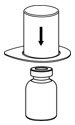
Fig. 2 - Carefully remove the clear package from the Mix2Vial transfer set. Make sure that you pull up only the clear package, not the Mix2Vial transfer set (Fig. 3).
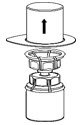
Fig. 3 - With the HUMATE-P vial placed firmly on a flat surface, invert the diluent vial with the Mix2Vial transfer set attached and push the plastic spike of the transparent adapter firmly through the center of the stopper of the HUMATE-P vial (Fig. 4). The diluent will automatically transfer into the HUMATE-P vial.
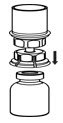
Fig. 4 - With the diluent and Humate-P vial still attached to the Mix2Vial transfer set, gently swirl the HUMATE-P vial to ensure that the HUMATE-P is fully dissolved (Fig. 5). Do not shake the vial.

Fig. 5 - With one hand grasp the HUMATE-P side of the Mix2Vial transfer set and with the other hand grasp the blue diluent-side of the Mix2Vial transfer set, and unscrew the set into two pieces (Fig. 6).
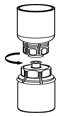
Fig. 6 - Draw air into an empty, sterile syringe. While the HUMATE-P vial is upright, screw the syringe to the Mix2Vial transfer set. Inject air into the HUMATE-P vial. While keeping the syringe plunger pressed, invert the system upside down and draw the concentrate into the syringe by pulling the plunger back slowly (Fig. 7).
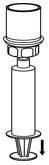
Fig. 7 - Now that the concentrate has been transferred into the syringe, firmly grasp the barrel of the syringe (keeping the syringe plunger facing down) and unscrew the syringe from the Mix2Vial transfer set (Fig. 8). Attach the syringe to a suitable intravenous administration set.
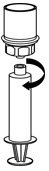
Fig. 8 - If patient requires more than one vial, pool the contents of multiple vials into one syringe. Use a separate unused Mix2Vial for each product vial.








Administration
HUMATE-P is for intravenous use only.
- The solution should be clear or slightly opalescent. After filtering/withdrawal, the reconstituted product should be inspected visually for particulate matter and discoloration prior to administration. Even if the directions for use for the reconstitution procedure are precisely followed, it is not uncommon for a few flakes or particles to remain. The filter included in the Mix2Vial device removes those particles completely. Filtration does not influence dosage calculations. Do not use visibly cloudy solutions or solutions still containing flakes or particles after filtration.
- Do not refrigerate HUMATE-P after reconstitution. Administer within 3 hours after reconstitution.
- Slowly infuse the solution (maximally 4 mL/minute) with a suitable intravenous administration set.
- Discard the administration equipment and any unused HUMATE-P after use.
More about Humate-P (antihemophilic factor/von willebrand factor)
- Check interactions
- Compare alternatives
- Pricing & coupons
- Reviews (3)
- Side effects
- During pregnancy
- Drug class: miscellaneous coagulation modifiers
- En español
Patient resources
Other brands
Professional resources
Other brands
Related treatment guides
Further information
Always consult your healthcare provider to ensure the information displayed on this page applies to your personal circumstances.
