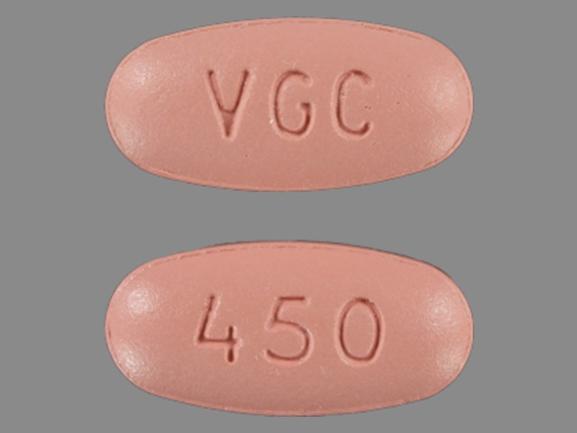
Valcyte (Oral)
Generic name: valganciclovir [ val-gan-SYE-kloe-vir ]
Drug class: Purine nucleosides
Medically reviewed by Drugs.com. Last updated on Jul 5, 2023.
Severe leukopenia, neutropenia, anemia, thrombocytopenia, pancytopenia, bone marrow failure including aplastic anemia have been reported in patients treated with valganciclovir hydrochloride. Based on animal and limited human data, valganciclovir hydrochloride may cause temporary or permanent inhibition of spermatogenesis in males and suppression of fertility in females. Based on animal data, valganciclovir hydrochloride has the potential to cause birth defects in humans. Based on animal data, valganciclovir hydrochloride has the potential to cause cancers in humans .
Uses for Valcyte
Valganciclovir is used to treat symptoms of cytomegalovirus (CMV) retinitis, an infection in the eyes of people with acquired immunodeficiency syndrome (AIDS). Valganciclovir will not cure this eye infection, but it may help to keep the symptoms from becoming worse.
Valganciclovir is an antiviral. It is used to treat infections caused by viruses. This medicine is also used to prevent CMV disease in patients who have received an organ transplant (eg, heart, kidney, or kidney-pancreas transplant).
This medicine may cause some serious side effects, including anemia and other blood problems. Before you begin treatment with valganciclovir, you and your doctor should talk about the benefit this medicine will do as well as the risks of using it.
This medicine is available only with your doctor's prescription.
Before using Valcyte
In deciding to use a medicine, the risks of taking the medicine must be weighed against the good it will do. This is a decision you and your doctor will make. For this medicine, the following should be considered:
Allergies
Tell your doctor if you have ever had any unusual or allergic reaction to this medicine or any other medicines. Also tell your health care professional if you have any other types of allergies, such as to foods, dyes, preservatives, or animals. For non-prescription products, read the label or package ingredients carefully.
Pediatric
Appropriate studies performed to date have not demonstrated pediatric-specific problems that would limit the usefulness of valganciclovir for the prevention of CMV disease in kidney and heart transplant children. However, safety and efficacy of valganciclovir for the prevention of CMV disease have not been established in liver transplant children, in kidney transplant children younger than 4 months of age, and in heart transplant children younger than 1 month of age.
Geriatric
Although appropriate studies on the relationship of age to the effects of valganciclovir have not been performed in the geriatric population, no geriatric-specific problems have been documented to date. However, elderly patients are more likely to have age-related liver, kidney, or heart problems, which may require caution and an adjustment in the dose for patients receiving valganciclovir.
Breast Feeding
There are no adequate studies in women for determining infant risk when using this medication during breastfeeding. Weigh the potential benefits against the potential risks before taking this medication while breastfeeding.
Interactions with Medicines
Although certain medicines should not be used together at all, in other cases two different medicines may be used together even if an interaction might occur. In these cases, your doctor may want to change the dose, or other precautions may be necessary. When you are taking this medicine, it is especially important that your healthcare professional know if you are taking any of the medicines listed below. The following interactions have been selected on the basis of their potential significance and are not necessarily all-inclusive.
Using this medicine with any of the following medicines is usually not recommended, but may be required in some cases. If both medicines are prescribed together, your doctor may change the dose or how often you use one or both of the medicines.
- Emtricitabine
- Imipenem
- Maribavir
- Tenofovir Alafenamide
Using this medicine with any of the following medicines may cause an increased risk of certain side effects, but using both drugs may be the best treatment for you. If both medicines are prescribed together, your doctor may change the dose or how often you use one or both of the medicines.
- Didanosine
Interactions with Food/Tobacco/Alcohol
Certain medicines should not be used at or around the time of eating food or eating certain types of food since interactions may occur. Using alcohol or tobacco with certain medicines may also cause interactions to occur. The following interactions have been selected on the basis of their potential significance and are not necessarily all-inclusive.
Using this medicine with any of the following may cause an increased risk of certain side effects but may be unavoidable in some cases. If used together, your doctor may change the dose or how often you use this medicine, or give you special instructions about the use of food, alcohol, or tobacco.
- High Fat Food
Other Medical Problems
The presence of other medical problems may affect the use of this medicine. Make sure you tell your doctor if you have any other medical problems, especially:
- Blood or bone marrow problems (eg, anemia, bone marrow aplasia, leukopenia, neutropenia, pancytopenia, thrombocytopenia)—Use with caution. May make these conditions worse.
- Kidney disease—Use with caution. The effects may be increased because of slower removal of the medicine from the body.
- Kidney disease, severe (hemodialysis)—Should not be used in patients with this condition.
Related/similar drugs
valacyclovir, valganciclovir, foscarnet, Prevymis, letermovir, fomivirsen ophthalmic, Cytovene
Proper use of Valcyte
Take this medicine exactly as directed by your doctor. Do not change the dose or stop using this medicine without checking first with your doctor. When your supply of this medicine is running low, contact your doctor or pharmacist ahead of time. Do not allow yourself to run out of this medicine.
This medicine should come with a patient information insert. Read and follow these instructions carefully. Ask your doctor if you have any questions.
It is important that you take this medicine with food. This is to make sure the medicine is fully absorbed into the body and will work properly.
Swallow the tablet whole. Do not break, crush, or chew it.
Be careful not to handle crushed or broken tablets. If you have contact with broken or crushed tablets or mixed oral liquid, wash your skin with soap and clear water. If the medicine gets into your eyes, rinse them with clear water.
If you are using the oral liquid, use the oral dispenser that comes with the package to measure each dose accurately. The average household teaspoon may not hold the right amount of liquid.
If you are taking ganciclovir (Cytovene®) capsules before switching to valganciclovir (Valcyte®) tablets, the dose of your medicine may change. Although these medicines both treat the same problem, they are absorbed differently by your body. Make sure you understand the new directions for Valcyte® so you do not take too many tablets.
To get the best results, valganciclovir must be given for the full time of treatment. Also, this medicine works best when there is a constant amount in the blood. To help keep the amount constant, valganciclovir must be taken on a regular schedule.
Dosing
The dose of this medicine will be different for different patients. Follow your doctor's orders or the directions on the label. The following information includes only the average doses of this medicine. If your dose is different, do not change it unless your doctor tells you to do so.
The amount of medicine that you take depends on the strength of the medicine. Also, the number of doses you take each day, the time allowed between doses, and the length of time you take the medicine depend on the medical problem for which you are using the medicine.
- For oral dosage forms (solution and tablets):
- For treatment of CMV infection in the eyes:
- Adults—At first, 900 milligrams (mg) (two 450 mg tablets) two times a day for 21 days. Then, your doctor may adjust your dose to 900 mg once a day.
- Children—Use and dose must be determined by your doctor.
- For prevention of CMV disease in transplant patients:
- Adults who have received heart or kidney-pancreas transplant—900 milligrams (mg) (two 450 mg tablets) once a day starting within 10 days of transplantation until 100 days after transplantation.
- Adults who have received kidney transplant—900 mg (two 450 mg tablets) once a day starting within 10 days of transplantation until 200 days after transplantation.
- Children 4 months to 16 years of age who have received a kidney transplant—Dose given once a day starting within 10 days of transplantation until 200 days after transplantation is based on body size and creatinine clearance which must be determined by your doctor. However, the dose is usually not more than 900 mg once a day.
- Children 1 month to 16 years of age who have received a heart transplant—Dose given once a day starting within 10 days of transplantation until 100 days after transplantation is based on body size and creatinine clearance which must be determined by your doctor. However, the dose is usually not more than 900 mg once a day.
- Children younger than 4 months old who have received a kidney transplant—Use and dose must be determined by your doctor.
- Children younger than 1 month old who have received a heart transplant—Use and dose must be determined by your doctor.
- For treatment of CMV infection in the eyes:
Missed Dose
If you miss a dose of this medicine, take it as soon as possible. However, if it is almost time for your next dose, skip the missed dose and go back to your regular dosing schedule. Do not double doses.
Storage
Keep out of the reach of children.
Do not keep outdated medicine or medicine no longer needed.
Ask your healthcare professional how you should dispose of any medicine you do not use.
Store the medicine in a closed container at room temperature, away from heat, moisture, and direct light. Keep from freezing.
Store the mixed oral liquid in the refrigerator. Do not freeze. Throw away any unused medicine after 49 days through community take-back programs when available.
Precautions while using Valcyte
It is very important that your doctor check the progress of you or your child at regular visits to make sure that this medicine is working properly. Blood and urine tests may be needed to check for unwanted effects.
Using this medicine while you are pregnant can harm your unborn baby. Use an effective form of birth control to keep from getting pregnant. You should not become pregnant while you are taking this medicine and for at least 1 month after stopping it. Also, men should use a condom during treatment with this medicine and for at least 90 days after treatment has been completed. If you think you have become pregnant while using the medicine, tell your doctor right away.
If you plan to have children, talk with your doctor before using this medicine. Some men and women using this medicine have become infertile (unable to have children).
Valganciclovir can temporarily lower the number of white blood cells in your blood, increasing the chance of getting an infection. It can also lower the number of platelets, which are necessary for proper blood clotting. If this occurs, there are certain precautions you can take, especially when your blood count is low, to reduce the risk of infection or bleeding:
- If you can, avoid people with infections. Check with your doctor immediately if you think you are getting an infection or if you get a fever or chills, cough or hoarseness, lower back or side pain, or painful or difficult urination.
- Check with your doctor immediately if you notice any unusual bleeding or bruising, black, tarry stools, blood in the urine or stools, or pinpoint red spots on your skin.
- Be careful when using a regular toothbrush, dental floss, or toothpick. Your medical doctor, dentist, or nurse may recommend other ways to clean your teeth and gums. Check with your medical doctor before having any dental work done.
- Be careful not to cut yourself when you are using sharp objects such as a safety razor or fingernail or toenail cutters.
- Avoid contact sports or other situations where bruising or injury could occur.
This medicine may cause kidney failure, especially in elderly patients with kidney problems. Check with your doctor right away if you have the following symptoms: agitation, coma, confusion, decreased urine output, depression, dizziness, headache, hostility, irritability, lethargy, muscle twitching, nausea, rapid weight gain, seizures, stupor, or swelling of the face, ankles, or hands.
This medicine may cause confusion, seizures, dizziness, drowsiness, or trouble in controlling movements. Make sure you know how you react to this medicine before you drive, use machines, or do anything else that could be dangerous if you are dizzy or are not alert.
Do not take other medicines unless they have been discussed with your doctor. This includes prescription or nonprescription (over-the-counter [OTC]) medicines and herbal or vitamin supplements.
Side Effects of Valcyte
Along with its needed effects, a medicine may cause some unwanted effects. Although not all of these side effects may occur, if they do occur they may need medical attention.
Check with your doctor immediately if any of the following side effects occur:
More common
- Black, tarry stools
- blood in the urine or stools
- blurred vision
- chills
- cough
- dizziness
- fever
- headache
- hoarseness
- lower back or side pain
- nervousness
- painful or difficult urination
- pale skin
- pinpoint red spots on the skin
- pounding in the ears
- seeing flashes or sparks of light
- seeing floating spots before the eyes
- shakiness in the legs, arms, hands, or feet
- shortness of breath
- slow or fast heartbeat
- sore throat
- trembling or shaking of the hands or feet
- troubled breathing
- troubled breathing with exertion
- ulcers, sores, or white spots in the mouth
- unusual bleeding or bruising
- unusual tiredness or weakness
- veil or curtain appearing across part of vision
Less common
- Changes in facial skin color
- confusion
- false beliefs
- fast or irregular breathing
- feeling, hearing, or seeing things that are not there
- hives, itching, and skin rash
- large, hive-like swellings on the eyelids, face, lips, mouth, or tongue
- puffiness or swelling of the eyelids or around the eyes
- runny or stuffy nose
- seizures
- tightness in the chest
- trouble thinking
Some side effects may occur that usually do not need medical attention. These side effects may go away during treatment as your body adjusts to the medicine. Also, your health care professional may be able to tell you about ways to prevent or reduce some of these side effects. Check with your health care professional if any of the following side effects continue or are bothersome or if you have any questions about them:
More common
- Abdominal or stomach pain
- diarrhea
- headache
- nausea and vomiting
- numbness, tingling, pain, or weakness of the hands or feet
- sleeplessness
- tingling, burning, or prickly sensations
- trouble with sleeping
- unsteadiness or awkwardness
Less common
- Agitation
Other side effects not listed may also occur in some patients. If you notice any other effects, check with your healthcare professional.
Call your doctor for medical advice about side effects. You may report side effects to the FDA at 1-800-FDA-1088.
Commonly used brand name(s)
In the U.S.
- Valcyte
Available Dosage Forms:
- Tablet
- Powder for Solution
Therapeutic Class: Antiviral
Pharmacologic Class: Viral DNA Polymerase Inhibitor
Chemical Class: Guanosine Nucleoside Analog
More about Valcyte (valganciclovir)
- Check interactions
- Compare alternatives
- Pricing & coupons
- Reviews (2)
- Drug images
- Side effects
- Dosage information
- During pregnancy
- Generic availability
- Drug class: purine nucleosides
- Breastfeeding
- En español
Patient resources
Professional resources
Related treatment guides
Further information
Always consult your healthcare provider to ensure the information displayed on this page applies to your personal circumstances.