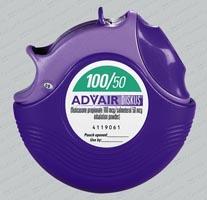
Advair Diskus (Inhalation)
Generic name: fluticasone and salmeterol [ floo-TIK-a-sone-PROE-pee-oh-nate, sal-ME-ter-ol-zye-NAF-oh-ate ]
Brand names: Advair Diskus, Advair Diskus 100/50, Advair Diskus 250/50, Advair Diskus 500/50, Advair HFA,
... show all 10 brands
Drug class: Bronchodilator combinations
Medically reviewed by Drugs.com. Last updated on Mar 15, 2024.
Uses for Advair Diskus
Fluticasone and salmeterol is a combination of two medicines that are used to help control the symptoms of asthma and improve breathing. It is used when a patient's asthma has not been controlled sufficiently on other asthma medicines, or when a patient's condition is so severe that more than one medicine is needed every day. This medicine will not relieve an asthma attack that has already started.
This medicine is also used to treat air flow blockage and reduce the worsening of chronic obstructive pulmonary disease (COPD). This includes chronic bronchitis and emphysema.
Inhaled fluticasone belongs to the family of medicines known as corticosteroids or steroids (cortisone-like medicines). It works by preventing certain cells in the lungs and breathing passages from releasing substances that cause asthma symptoms.
Inhaled salmeterol is a long-acting bronchodilator. Bronchodilators are medicines that are breathed in through the mouth to open up the bronchial tubes (air passages) in the lungs. It relieves cough, wheezing, shortness of breath, and troubled breathing by increasing the flow of air through the bronchial tubes.
This medicine must be used with a short-acting medicine (eg, albuterol) for an asthma attack or asthma symptoms that need attention right away.
This medicine is available only with your doctor's prescription.
Before using Advair Diskus
In deciding to use a medicine, the risks of taking the medicine must be weighed against the good it will do. This is a decision you and your doctor will make. For this medicine, the following should be considered:
Allergies
Tell your doctor if you have ever had any unusual or allergic reaction to this medicine or any other medicines. Also tell your health care professional if you have any other types of allergies, such as to foods, dyes, preservatives, or animals. For non-prescription products, read the label or package ingredients carefully.
Pediatric
Appropriate studies performed to date have not demonstrated pediatric-specific problems that would limit the usefulness of Advair® Diskus® to treat asthma in children older than 4 years of age. Safety and efficacy have not been established in children younger than 4 years of age.
Appropriate studies have not been performed on the relationship of age to the effects of Advair® HFA oral inhalation or Airduo™ Respiclick® in children younger than 12 years of age. Safety and efficacy have not been established.
Geriatric
Appropriate studies performed to date have not demonstrated geriatric-specific problems that would limit the usefulness of fluticasone and salmeterol combination in the elderly. However, elderly patients are more likely to have age-related liver, kidney, or heart problems, which may require caution and an adjustment in the dose for patients receiving this medicine. Also, elderly people with heart and blood vessel problems may require special caution when receiving fluticasone and salmeterol combination.
Breast Feeding
There are no adequate studies in women for determining infant risk when using this medication during breastfeeding. Weigh the potential benefits against the potential risks before taking this medication while breastfeeding.
Interactions with Medicines
Although certain medicines should not be used together at all, in other cases two different medicines may be used together even if an interaction might occur. In these cases, your doctor may want to change the dose, or other precautions may be necessary. When you are taking this medicine, it is especially important that your healthcare professional know if you are taking any of the medicines listed below. The following interactions have been selected on the basis of their potential significance and are not necessarily all-inclusive.
Using this medicine with any of the following medicines is not recommended. Your doctor may decide not to treat you with this medication or change some of the other medicines you take.
- Desmopressin
- Levoketoconazole
Using this medicine with any of the following medicines is usually not recommended, but may be required in some cases. If both medicines are prescribed together, your doctor may change the dose or how often you use one or both of the medicines.
- Abametapir
- Acebutolol
- Adagrasib
- Arotinolol
- Aspirin
- Atazanavir
- Atenolol
- Befunolol
- Belzutifan
- Bemiparin
- Betaxolol
- Bevantolol
- Bisoprolol
- Boceprevir
- Bopindolol
- Bucindolol
- Bupranolol
- Bupropion
- Carteolol
- Carvedilol
- Celiprolol
- Ceritinib
- Clarithromycin
- Cobicistat
- Conivaptan
- Dabrafenib
- Darunavir
- Dasabuvir
- Dilevalol
- Duvelisib
- Esmolol
- Fedratinib
- Fexinidazole
- Fluconazole
- Fosnetupitant
- Idelalisib
- Indinavir
- Itraconazole
- Ivosidenib
- Josamycin
- Ketoconazole
- Labetalol
- Landiolol
- Larotrectinib
- Lefamulin
- Lenacapavir
- Levobunolol
- Lonafarnib
- Lopinavir
- Lorlatinib
- Lumacaftor
- Lutetium Lu 177 Dotatate
- Macimorelin
- Mavacamten
- Mepindolol
- Methacholine
- Metipranolol
- Metoprolol
- Mibefradil
- Mifepristone
- Nadolol
- Nadroparin
- Nebivolol
- Nefazodone
- Nelfinavir
- Netupitant
- Nilotinib
- Nirmatrelvir
- Olutasidenib
- Omaveloxolone
- Ombitasvir
- Oxprenolol
- Pacritinib
- Paritaprevir
- Penbutolol
- Phenobarbital
- Pindolol
- Pirtobrutinib
- Posaconazole
- Practolol
- Primidone
- Propranolol
- Ribociclib
- Ritlecitinib
- Ritonavir
- Saquinavir
- Sargramostim
- Somatrogon-ghla
- Sotalol
- Talinolol
- Telaprevir
- Telithromycin
- Tertatolol
- Timolol
- Tipranavir
- Tocilizumab
- Trofinetide
- Troleandomycin
- Tucatinib
- Voriconazole
Using this medicine with any of the following medicines may cause an increased risk of certain side effects, but using both drugs may be the best treatment for you. If both medicines are prescribed together, your doctor may change the dose or how often you use one or both of the medicines.
- Auranofin
Interactions with Food/Tobacco/Alcohol
Certain medicines should not be used at or around the time of eating food or eating certain types of food since interactions may occur. Using alcohol or tobacco with certain medicines may also cause interactions to occur. The following interactions have been selected on the basis of their potential significance and are not necessarily all-inclusive.
Using this medicine with any of the following is usually not recommended, but may be unavoidable in some cases. If used together, your doctor may change the dose or how often you use this medicine, or give you special instructions about the use of food, alcohol, or tobacco.
- Grapefruit Juice
Other Medical Problems
The presence of other medical problems may affect the use of this medicine. Make sure you tell your doctor if you have any other medical problems, especially:
- Asthma attack, acute or
- Bronchospasm (difficulty with breathing), acute or
- COPD flare-up or
- Milk protein allergy, severe—Should not be used in patients with these conditions.
- Blood vessel disease (eg, Churg-Strauss syndrome) or
- Bone problems (eg, osteoporosis) or
- Cataracts or
- Diabetes or
- Glaucoma or
- Heart disease or
- Heart rhythm problems (eg, arrhythmia) or
- Hypertension (high blood pressure) or
- Hyperthyroidism (overactive thyroid) or
- Hypokalemia (low potassium in the blood) or
- Ketoacidosis (high ketones in the blood) or
- Seizures, history of—Use with caution. May make these conditions worse.
- Chickenpox (including recent exposure) or
- Herpes simplex (virus) infection of the eye or
- Infections (eg, virus, bacteria, or fungus) or
- Measles (including recent exposure) or
- Tuberculosis, active or history of—Inhaled fluticasone can reduce the body's ability to fight off these infections.
- Infection or
- Stress or
- Surgery or
- Trauma—Supplementary oral corticosteroids may be needed. Check with your doctor.
- Liver disease—Use with caution. The effects may be increased because of slower removal of the medicine from the body.
Proper use of Advair Diskus
Inhaled fluticasone and salmeterol is used to prevent asthma attacks and to treat chronic obstructive pulmonary disease (COPD). It is not used to relieve an asthma attack that has already started. For relief of an asthma attack that has already started, you should use another medicine. If you do not have another medicine to use for an attack or if you have any questions about this, check with your doctor.
Inhaled fluticasone and salmeterol is used with a special inhaler that comes with a patient information leaflet or patient instructions. Read the directions carefully before using this medicine. If you do not understand the directions or you are not sure how to use the Diskus® or inhaler, ask your doctor to show you what to do. Also, ask your doctor to check regularly how you use the Diskus® or inhaler to make sure you are using it properly.
Use this medicine only as directed by your doctor. Do not use more of it and do not use it more often than your doctor ordered. Also, do not stop using this medicine without telling your doctor first. To do so may increase the chance of side effects.
In order for this medicine to help prevent asthma attacks, it must be used every day in regularly spaced doses, as ordered by your doctor.
Do not stop using this medicine or other asthma medicines that your doctor has prescribed for you unless you have discussed this with your doctor.
When you use the Advair® HFA inhaler for the first time, or if you have not used it for 4 weeks or longer, or if the inhaler has been dropped, it may not deliver the right amount of medicine with the first puff. Therefore, before using the inhaler, prime it by spraying the medicine four times into the air away from the face, and shaking it well for 5 seconds before each spray. Avoid spraying it in your eyes.
Rinsing your mouth with water after each dose may help prevent hoarseness, throat irritation, and infection in the mouth. However, do not swallow the water after rinsing.
To use the Diskus®:
- Open the foil pouch containing the Diskus®.
- To open the Diskus®, push the thumb grip away from you as far as it will go. You will hear a click and feel a snap. When open, the mouthpiece will appear.
- Slide the mouthpiece lever away from you as far as it will go until it clicks. The Diskus® is now ready to use. If you close the Diskus® or push the lever again, you will lose the medicine.
- Turn your head away from the Diskus®, and breathe out to the end of a normal breath. Do not breathe into the Diskus®.
- Holding the Diskus® level, put the mouthpiece between your lips and teeth, and close your lips around the mouthpiece. Do not bite down on the mouthpiece. Do not block the mouthpiece with your teeth or tongue.
- Breathe in through your mouth as deeply as you can until you have taken a full deep breath. Do not breathe through your nose.
- Hold your breath and remove the mouthpiece from your mouth. Continue holding your breath as long as you can up to 10 seconds before breathing out slowly. This gives the medicine time to settle in your airways and lungs.
- Turn your head away from the Diskus®, and breathe out slowly to the end of a normal breath. Do not breathe into the Diskus®.
- If your doctor has told you to inhale more than one puff of medicine at each dose, take the second puff following exactly the same steps you used for the first puff.
- When you are finished, close the Diskus®. Place your thumb on the thumb grip, and slide it back toward you as far as it will go. You will hear it click shut.
- Keep the Diskus® dry. Do not wash the mouthpiece, or any other part of the Diskus®. You may use a dry cloth to wipe it clean.
- The Diskus® has a window that shows the number of doses that are left. This tells you when you are getting low on medicine. When the Diskus® has 5 doses left, the numbers from 5 to 0 will show up in red to remind you to refill your prescription.
To use the Advair® HFA inhaler:
- Take the inhaler out of the pouch before you use it for the first time.
- Do not use the inhaler for this medicine with any other medicine.
- Remove the cap and look at the mouthpiece to make sure it is clean.
- Prime the inhaler before use by shaking the inhaler well and then releasing 4 test sprays.
- To inhale this medicine, breathe out fully, trying to get as much air out of the lungs as possible. Put the mouthpiece fully into your mouth and close your lips around it. Do not block the mouthpiece with your teeth or tongue.
- While pressing down firmly and fully on the purple top of the inhaler, breathe in through your mouth as deeply as you can until you have taken a full deep breath.
- Wait for 30 seconds and repeat these steps for the next puff, starting with shaking the inhaler.
- Gargle and rinse your mouth with water after each dose. This will help prevent hoarseness, throat irritation, and infection in the mouth. Do not swallow the water after rinsing.
- Replace the mouthpiece cover after using the medicine.
- The inhaler has a window that shows the number of doses remaining. This tells you when you are getting low on medicine. The doses counting down from 20 to 0 will show up in red to remind you to refill your prescription. Throw away the inhaler when the count is 000.
To use the Airduo™ Respiclick®:
- Take the inhaler out of the pouch before you use it for the first time.
- Do not use the inhaler for this medicine with any other medicine.
- This medicine does not require priming. Do not use it with a spacer or volume holding chamber.
- Hold the inhaler upright and open the yellow cap all the way until it clicks. Do not open the yellow cap until you are ready to take a dose of this medicine.
- To inhale this medicine, breathe out fully, trying to get as much air out of the lungs as possible. Put the mouthpiece fully into your mouth and close your lips around it. Do not block the mouthpiece with your teeth or tongue. Do not block the vent above the mouthpiece with your lips or fingers.
- Breathe in through your mouth quickly and deeply as you can until you have taken a full deep breath. Hold your breath for about 10 seconds.
- Close the yellow cap after each inhalation. Rinse your mouth with water without swallowing after each inhalation.
- Keep the inhaler dry and clean at all times. Gently wipe the mouthpiece with a dry cloth or tissue as needed.
- The inhaler has a window that shows the number of doses remaining. This tells you when you are getting low on medicine. The doses counting down from 20 to 0 will show up in red to remind you to refill your prescription. Throw away the inhaler when the dose counter displays 0, 30 days after opening the pouch.
Dosing
The dose of this medicine will be different for different patients. Follow your doctor's orders or the directions on the label. The following information includes only the average doses of this medicine. If your dose is different, do not change it unless your doctor tells you to do so.
The amount of medicine that you take depends on the strength of the medicine. Also, the number of doses you take each day, the time allowed between doses, and the length of time you take the medicine depend on the medical problem for which you are using the medicine.
- For inhalation dosage form (aerosol liquid):
- For preventing an asthma attack:
- Adults and children 12 years of age and older—2 puffs in the morning and another 2 puffs in the evening. The doses should be at least 12 hours apart.
- Children younger than 12 years of age—Use and dose must be determined by your child's doctor.
- For preventing an asthma attack:
- For inhalation dosage form (aerosol powder):
- Advair® Diskus®:
- For preventing an asthma attack:
- Adults and children 12 years of age and older—1 inhalation 2 times per day (morning and evening). The doses should be at least 12 hours apart. Your doctor may adjust your dose as needed. However, the dose is not more than 500 micrograms (mcg) of fluticasone and 50 mcg of salmeterol two times a day.
- Children 4 to 11 years of age—1 inhalation 2 times per day (morning and evening). The doses should be at least 12 hours apart. Each inhalation contains 100 micrograms (mcg) of fluticasone and 50 mcg of salmeterol.
- Children younger than 4 years of age—Use and dose must be determined by your doctor.
- For treatment and prevention of worsening attacks of COPD:
- Adults—1 inhalation 2 times per day (morning and evening). The doses should be at least 12 hours apart. Each inhalation contains 250 micrograms (mcg) of fluticasone and 50 mcg of salmeterol.
- Children—Use and dose must be determined by your doctor.
- For preventing an asthma attack:
- Airduo™ Respiclick®:
- For treatment of asthma:
- Adults and children 12 years of age and older—1 inhalation 2 times per day (morning and evening). The doses should be at least 12 hours apart. Do not use it more than 2 times every 24 hours.
- Children younger than 12 years of age—Use and dose must be determined by your child's doctor.
- For treatment of asthma:
- Advair® Diskus®:
Missed Dose
If you miss a dose of this medicine, skip the missed dose and go back to your regular dosing schedule. Do not double doses.
Storage
Store the canister at room temperature, away from heat and direct light. Do not freeze. Do not keep this medicine inside a car where it could be exposed to extreme heat or cold. Do not poke holes in the canister or throw it into a fire, even if the canister is empty.
Keep the medicine in the foil pouch until you are ready to use it. Store at room temperature, away from heat and direct light. Do not freeze.
Keep out of the reach of children.
Do not keep outdated medicine or medicine no longer needed.
Ask your healthcare professional how you should dispose of any medicine you do not use.
Precautions while using Advair Diskus
If you will be using this medicine for a long time, it is very important that your doctor check the progress of you or your child at regular visits. This will allow your doctor to see if the medicine is working properly and to check for any unwanted effects.
Tell your doctor if you or your child are also using other medicines for your COPD. Your doctor may want you to stop using the medicine and use it only during a severe COPD attack. Follow your doctor's instructions on how you should take your medicine.
This medicine should not be used if you are having a severe COPD attack, or if symptoms of a COPD attack has already started. Your doctor may prescribe another medicine for you to use in case of an acute COPD attack. If the other medicine does not work as well, tell your doctor right away.
This medicine should only be used as an additional treatment for patients who cannot be treated with other asthma medicines (such as inhaled corticosteroids) or for asthma patients that require two medicines, including salmeterol. Ask your doctor if you have any questions.
Although this medicine decreases the number of asthma episodes, it may increase the chance of a severe asthma attack when they do occur. Be sure to read about these risks in the patient information leaflet and talk to your doctor or pharmacist about any questions or concerns that you have.
You should not use this medicine if your asthma attack has already started. Your doctor will prescribe another medicine (eg, a short-acting inhaler) for you to use in case of an acute asthma attack. Make sure you understand how to use the short-acting inhaler. Talk to your doctor if you need instructions.
Talk with your doctor or get medical care right away if:
- Your or your child's symptoms do not improve after using this medicine for 1 week or if they become worse.
- Your short-acting inhaler does not seem to work as well as it used to and you or your child need it more often than normal (eg, you use 1 whole canister of the short-acting inhaler in 8 weeks time, or you need to use 4 or more inhalations of the short-acting inhaler for 2 or more days in a row).
- You or your child have a big decrease in your peak flow when measured as directed by your doctor.
Do not use this medicine to treat wheezing that is getting worse. Call your doctor right away if wheezing worsens while using this medicine.
Do not use any other asthma medicine or medicine for breathing problems without talking to your doctor. This medicine should not be used with other inhalers that contain budesonide and formoterol combination (Symbicort®), formoterol (Foradil® Aerolizer®, Perforomist™), or arformoterol (Brovona™).
This medicine may cause a fungus infection of the mouth or throat (thrush). Tell your doctor right away if you have white patches in the mouth or throat, or pain when eating or swallowing.
Patients with COPD may be more likely to have pneumonia. Call your doctor if you or your child start having increased sputum (spit) production, change in sputum color, fever, chills, increased cough, or an increase in breathing problems.
Do not change your dose or stop using your medicine without first asking your doctor.
Your doctor may want you to carry a medical identification (ID) card stating that you or your child are using this medicine. The card will say that you may need additional medicine during an emergency, a severe asthma attack or other illness, or unusual stress.
Using too much of this medicine or using it for a long time may increase your risk of having adrenal gland problems. Talk to your doctor if you or your child have more than one of these symptoms while you are using this medicine: darkening of the skin, diarrhea, dizziness, fainting, loss of appetite, mental depression, nausea, skin rash, unusual tiredness or weakness, or vomiting.
This medicine may cause paradoxical bronchospasm, which may be life-threatening. Check with your doctor right away if you or your child are having a cough, difficulty with breathing, shortness of breath, or wheezing after using this medicine.
If you or your child develop a skin rash, hives, or any allergic reaction (including anaphylaxis) to this medicine, check with your doctor right away.
Check with your doctor right away if you or your child have chest pain, a fast heartbeat, nervousness, shaking of the hands or feet, noisy breathing, a feeling of choking, or tightness or irritation of the throat while using this medicine.
This medicine may affect blood sugar and potassium levels. If you have heart disease or are diabetic and notice a change in the results of your blood or urine sugar or potassium tests, check with your doctor.
Check with your doctor right away if blurred vision, difficulty in reading, or any other change in vision occurs during or after treatment with this medicine. Your doctor may want you or your child to have your eyes checked by an ophthalmologist (eye doctor).
This medicine may decrease bone mineral density when used for a long time. A low bone mineral density can cause weak bones or osteoporosis. If you have any questions about this, ask your doctor.
This medicine may cause children to grow more slowly than usual. Talk to your child's doctor if you have any concerns.
Do not take other medicines unless they have been discussed with your doctor. This includes prescription or nonprescription (over-the-counter [OTC]) medicines and herbal or vitamin supplements.
Side Effects of Advair Diskus
Along with its needed effects, a medicine may cause some unwanted effects. Although not all of these side effects may occur, if they do occur they may need medical attention.
Check with your doctor immediately if any of the following side effects occur:
More common
- Black, tarry stools
- blindness
- blurred vision
- burning, tingling, numbness, or pain in the hands, arms, feet, or legs
- chills
- cough
- decreased vision
- difficulty with breathing or swallowing
- eye pain
- fast heartbeat
- fever
- headache
- hives or welts, skin itching, rash, or redness
- large, hive-like swelling on the face, eyelids, lips, tongue, throat, hands, legs, feet, or sex organs
- nausea
- noisy breathing
- painful or difficult urination
- sensation of pins and needles
- sore throat
- sores, ulcers, or white spots on the lips or in the mouth
- stabbing pain in the arms or legs
- swollen glands
- tearing
- unusual bleeding or bruising
- vomiting
Incidence not known
- Backache
- bruising
- darkening of the skin
- decrease in height
- diarrhea
- difficulty with moving
- dizziness
- facial hair growth in females
- fainting
- fast, slow, pounding, or irregular heartbeat or pulse
- flushed, dry skin
- fractures
- fruit-like breath odor
- full or round face, neck, or trunk
- heavy bleeding
- increased hunger
- increased thirst or urination
- irritability
- large, flat, blue, or purplish patches in the skin
- loss of sexual desire or ability
- menstrual irregularities
- mental depression
- muscle pain or stiffness
- muscle wasting
- pain in the back, ribs, arms, or legs
- pain in the joints
- stomach pain
- sweating
- unexplained weight loss
- unusual tiredness or weakness
- weight gain
Get emergency help immediately if any of the following symptoms of overdose occur:
Symptoms of overdose
- Chest pain or tightness
- confusion
- decreased urine output
- dry mouth
- faintness, or lightheadedness when getting up suddenly from a lying or sitting position
- general feeling of discomfort or illness
- high blood pressure
- loss of appetite
- mood changes
- nervousness
- numbness or tingling in the hands, feet, or lips
- seizures
- sudden sweating
- tremors
- trouble with sleeping
Some side effects may occur that usually do not need medical attention. These side effects may go away during treatment as your body adjusts to the medicine. Also, your health care professional may be able to tell you about ways to prevent or reduce some of these side effects. Check with your health care professional if any of the following side effects continue or are bothersome or if you have any questions about them:
More common
- Body aches or pain
- choking
- congestion
- dryness of the throat
- high-pitched noise when breathing
- hoarseness
- runny nose
- sneezing
- trouble with swallowing
- voice changes
Less common
- Cough-producing mucus
- irritation or inflammation of the eye
- muscle pain
- pain or tenderness around the eyes and cheekbones
- sleep disorders
- stuffy nose
- white patches in the mouth or throat or on the tongue
Other side effects not listed may also occur in some patients. If you notice any other effects, check with your healthcare professional.
Call your doctor for medical advice about side effects. You may report side effects to the FDA at 1-800-FDA-1088.
Commonly used brand name(s)
In the U.S.
- Advair Diskus
- Advair Diskus 100/50
- Advair Diskus 250/50
- Advair Diskus 500/50
- Advair HFA
- Advair HFA 115/21
- Advair HFA 230/21
- Advair HFA 45/21
- AirDuo Digihaler with eModule
- Airduo Respiclick
In Canada
- Advair
- Advair Inhalation Aerosol
Available Dosage Forms:
- Powder
- Disk
- Aerosol Liquid
Therapeutic Class: Antiasthma, Anti-Inflammatory/Bronchodilator Combination
Pharmacologic Class: Fluticasone
Frequently asked questions
More about Advair Diskus (fluticasone / salmeterol)
- Check interactions
- Compare alternatives
- Pricing & coupons
- Reviews (113)
- Drug images
- Side effects
- Dosage information
- During pregnancy
- Generic availability
- Support group
- Drug class: bronchodilator combinations
- En español
Patient resources
- Advair drug information
- Advair Diskus
- Advair Diskus 100/50 (Advanced Reading)
- Advair Diskus 250/50 (Advanced Reading)
- Advair Diskus 500/50 (Advanced Reading)
Other brands
Wixela Inhub, Advair HFA, AirDuo Digihaler, AirDuo Respiclick
Professional resources
Other brands
Wixela Inhub, AirDuo Digihaler, AirDuo Respiclick
Related treatment guides
Further information
Always consult your healthcare provider to ensure the information displayed on this page applies to your personal circumstances.