
Hydrocephalus in Children
Medically reviewed by Drugs.com. Last updated on Apr 2, 2024.
What is hydrocephalus?
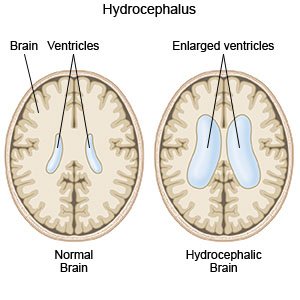
Hydrocephalus is a condition caused by too much cerebrospinal fluid (CSF) inside the ventricles of your child's brain. Ventricles are spaces inside the brain where cerebrospinal fluid (CSF) is produced. CSF surrounds your child's brain and spinal cord. CSF is constantly being made and absorbed by your child's body. It moves through ventricles before it drains out and gets absorbed into the bloodstream. When CSF cannot drain properly, the fluid pressure may cause the ventricles to swell.
 |
What increases my child's risk for hydrocephalus?
Your child may have been born with hydrocephalus. The following can also increase his or her risk:
- Infections in the mother during pregnancy caused by bacteria or a virus
- Problems during the growth of the fetus that may cause defects in the brain
- Head injuries or trauma
- Infections in the brain and its coverings
- Prematurity (being born too early), which may increase his or her risk for bleeding in the brain
- Tumors that may decrease or block the flow of CSF
What are the signs and symptoms of hydrocephalus?
- Infants and young children: The most common sign is a rapid increase in head size. The head size increases because the bones of a baby's skull have not yet fused together. Other signs and symptoms include the following:
- Eyes that are turned downward
- Bulging fontanelles (soft spots of the head)
- Fussiness, restlessness, or crying more than normal
- Problems with holding the head up, or frequent bobbing of the head
- Seizures
- Sleepiness
- Vomiting
- Older children: The bones of the skull in older children may have fused, which may cause different symptoms than those seen in infants:
- Blurring of vision or double vision
- Drowsiness
- Headaches that have occurred over a long period of time
- Nausea or vomiting
- Mood changes, learning problems, and memory loss
- Problems in controlling urination
- Problems with balance and walking
How is hydrocephalus diagnosed?
Your child's healthcare provider will examine your child's head and measure it's size. Your child may also need any of the following:
- Neuro signs , or neuro checks show healthcare providers your child's brain function. They will check how your child's pupils react to light. They may check his or her memory and how easily he or she wakes up. Your child's strength, balance, vision, and other brain functions may also be tested.
- An ultrasound, CT, or MRI may show bleeding, extra fluid, or blockage. Your child may be given contrast liquid to help his or her brain show up better in the pictures. Tell the healthcare provider if your child has ever had an allergic reaction to contrast liquid. Do not enter the MRI room with anything metal. Metal can cause serious injury. Tell the healthcare provider if your child has any metal in or on his or her body.
- A lumbar puncture , or spinal tap, is a procedure to collect a sample of CSF fluid to check for infection or test CSF pressure.
How is hydrocephalus treated?
Treatment should begin as soon as possible to prevent brain injury.
- Surgery:
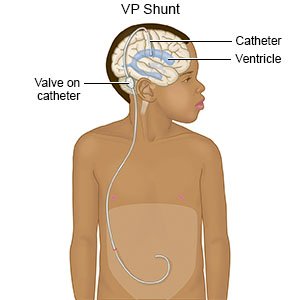
- Shunt placement helps drain extra CSF fluid through a tube from your child's brain into his or her abdomen where it is absorbed.
- Ventriculostomy helps drain the extra CSF fluid through a small hole in your child's brain.
- Shunt placement helps drain extra CSF fluid through a tube from your child's brain into his or her abdomen where it is absorbed.
- Medicines may help decrease the swelling your child's brain or treat a bacterial infection.
Treatment options
The following list of medications are related to or used in the treatment of this condition.
Call your local emergency number (911 in the US) if:
- Your child has a seizure.
When should I seek immediate care?
- Your child has a bulging fontanel (soft spot on the top of his or her head).
- Your child's headache is getting worse, even after you give him or her pain medicine.
- Your child has trouble hearing, talking, or seeing.
- Your child has problems walking or weakness in an arm or leg.
- Your child is vomiting and cannot keep any liquids down.
When should I call my child's doctor?
- Your child has a fever.
- Your child becomes more fussy, restless, or sleepy than usual.
- Your child seems confused or does not know family or friends.
- You have questions or concerns about your child's condition or care.
Care Agreement
You have the right to help plan your child's care. Learn about your child's health condition and how it may be treated. Discuss treatment options with your child's healthcare providers to decide what care you want for your child. The above information is an educational aid only. It is not intended as medical advice for individual conditions or treatments. Talk to your doctor, nurse or pharmacist before following any medical regimen to see if it is safe and effective for you.© Copyright Merative 2024 Information is for End User's use only and may not be sold, redistributed or otherwise used for commercial purposes.
Learn more about Hydrocephalus
Treatment options
- Medications for Brain Anomalies incl Congenital
- Medications for Central Nervous System Disorders
- Medications for Hydrocephalus
Care guides
Symptoms and treatments
Further information
Always consult your healthcare provider to ensure the information displayed on this page applies to your personal circumstances.
