How To Use A Nebulizer
WHAT YOU SHOULD KNOW:
- A nebulizer (NEB-yu-lie-zer) is a device for breathing treatments to help you breathe better. It changes liquid medicine into a very fine mist. The mist goes into your airways and lungs when you breathe in. Nebulizer treatments may be given to infants, children, and adults. You may receive nebulizer treatments when you are in the hospital. Nebulizer treatments can also be done at home. You may need to use a nebulizer if you have asthma or lung diseases, such as cystic fibrosis and bronchiectasis.
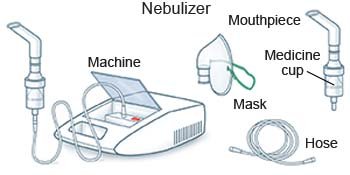
- A nebulizer usually consists of parts that make the mist, and a machine to power the nebulizer. The machine may be mechanical or ultrasonic. A mechanical compressor makes mist from liquid medicines using compressed air that passes through a narrow hole. An ultrasonic machine makes very high speed vibrations to create a mist. The mist is made in the nebulizer in a container for the medicine that may be used again. The container or machine may have a valve that controls the flow of air to increase the amount of mist you receive. A mouthpiece or mask connects to the medicine container to bring the mist to your lungs. Knowing how to use your nebulizer correctly will help ease your trouble breathing.
![]() |
AFTER YOU LEAVE:
Medicines:
- Keep a written list of the medicines you take, the amounts, and when and why you take them. Bring the list of your medicines or the pill bottles when you see your caregivers. Learn why you take each medicine. Ask your caregiver for information about your medicine. Do not use any medicines, over-the-counter drugs, vitamins, herbs, or food supplements without first talking to caregivers.
- Always take your medicine as directed by caregivers. Call your caregiver if you think your medicines are not helping or if you feel you are having side effects. Do not quit taking your medicines until you discuss it with your caregiver. If you are taking medicine that makes you drowsy, do not drive or use heavy equipment.
Ask your caregiver when to return for a follow-up visit. Keep all appointments. Write down any questions you may have. This way you will remember to ask these questions during your next visit.
Medicines that may be given using a nebulizer:
- Antibiotics: These medicines fight lung infections caused by bacteria. They may before diseases such as cystic fibrosis and bronchiectasis. These medicines improve lung function and decrease symptoms.
- Bronchodilators: These medicines stop body reflexes that make your airways smaller, to help you to breathe easier. Their effects may last for 4 to 6 hours (short acting) or for 12 hours (long acting). You may feel that your heart is beating faster or that your hands are shaking after using them. They may blur your vision for a short time or worsen glaucoma if they go to your eyes. Close your mouth when inhaling these medicines to prevent this. Dry mouth, another side effect, can be avoided by rinsing your mouth and spitting out the rinse water.
- Corticosteroids: These drugs decrease the inflammation in your airways. They may help if you often have trouble breathing from a long-term lung disease. You may be instructed to inhale a bronchodilator first before using this medicine to prevent spasm (fast tightening) in your airways. You may get a fungal infection in your mouth when you use this medicine often. Rinse your mouth every time after you use this medicine.
- Prostanoids: These drugs relax blood vessels and increase blood flow and oxygen to damaged areas of the lungs. They are used in those with severe (very bad) lung infection or sudden airway problems.
Using your nebulizer:
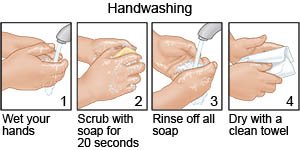
- Wash your hands.
- Prepare the compressor machine. Place the machine on a hard surface. Look to see if the air filter is clean. If you see that it is dirty, rinse it using cold water and let it air dry. Plug in the machine to an electrical outlet.
- Prepare the medicine. If your medicine is in a pre-mixed, single dose vial, open and place it in the nebulizer medicine container. If you have to mix medicines, place the right amounts into the container using a dropper or syringe. Call your caregiver if you have questions or concerns about mixing medicines.
- Add saline if needed. Some medicines may need to have saline (special salt water) added. If saline needs to be added, buy sterile normal saline. Never put homemade saline solution into a nebulizer.
- Connect the medicine container to the machine. Attach the nebulizer medicine container to the tubing that is connected to the compressor machine.
- Attach the delivery piece to the container. Attach the mouth piece or mask to the medicine container.
- Adults and older children: Place the mouth piece in your mouth. Breathe in and out slowly through your mouth until all the medicine is gone.
- Infants and younger children: For your child, place the mask on his face. You may need to distract your child during the treatment to keep him from removing the mask. Let your child watch a video he likes or play with toys during the treatment.
- Adults and older children: Place the mouth piece in your mouth. Breathe in and out slowly through your mouth until all the medicine is gone.
- Give the treatment. Turn one the machine. Keep the medicine container in a straight up position. Towards the end of the treatment, you may need to tap the sides of the container. This will move the last of the medicine down to the air jet to be misted. The whole treatment may take 8 to 10 minutes. The treatment is over when all the medicine is gone or there is no more mist coming out. The machine may also make a sputtering noise when treatment is done.
Advantages of using a nebulizer: Nebulizers can be used at any age. You can mix more than one medicine, and they can all be given at the same time. Very high doses of drugs can also be used. The delivery of medicine is done during normal breathing. No special breathing techniques are needed to use a nebulizer.
Disadvantages of using a nebulizer: The machine is noisy and needs an electrical power source for it to function. Compared to other inhalation devices, it is larger, less portable, and has a longer treatment time. It may also be more expensive than other devices because of the rental or purchase cost of the machine. The parts that get wet with the treatment need to be rinsed after every use. Not all medicines can be used with a nebulizer. Your airways may get irritated when you breathe in some medicines.
"Smart nebulizers": These are mechanical nebulizers that have been changed to improve the shortcomings of the traditional compressor machine. These newer machines may use your breathing pattern for better drug delivery. They may reduce other problems such as the size and weight of the machine or device. They may also not need to be plugged in for electrical power.
Taking care of your nebulizer: The parts that get wet during the treatment must be cleaned to keep germs from growing on them. You do not need to rinse the tubing that connects the machine to the medicine container.
- Wash after every use: Wash the container and mouthpiece or mask with dishwashing detergent under hot, running water. Shake off the excess water and let the parts air dry. Remove any mucus or medicine stuck to the machine or tubing.
- Disinfect at least three times a week: Even with washing after every use, germs can still grow on the nebulizer parts. These germs can cause lung infection. Soak the nebulizer parts in diluted white vinegar or the disinfecting solution that your caregiver recommends. Do this for the amount of time he tells you to do it. Rinse the parts after soaking, according to his instructions, and let them air dry. This should kill most or all of the germs on the nebulizer parts.
Nebulizer use in children:
- There should be a tight fit between your child's face and mask for the medicine to reach his lungs. If your child is crying, little of the inhaled medicine may reach his lungs. If your child is fighting the treatment, the seal around his face and mask may loosen. Do not hold the mouthpiece or tubing near your child's nose or mouth. This will not deliver the drug to the lungs. Quiet inhalation is the best way for the drug to reach the airways. Encourage your child's interest in quiet play activities while giving the treatment to prevent struggling.
- Make sure that you follow your caregiver's instructions on how to use the machine properly. Not following treatment and machine instructions is a problem in all age groups, but more so in children. Struggling to give the inhaled medicine to your child also decreases your willingness to give the treatment. You may want to use a reward system to encourage your child to not resist the treatment.
CONTACT A CAREGIVER IF:
- Your hands, arms, or legs are shaking after the treatment.
- You have a fast heartbeat and feel dizzy.
- You have a mouth infection.
- Your symptoms do not improve even with treatment.
- You have questions or concerns about your disease or treatment.
SEEK CARE IMMEDIATELY IF:
- You are having a hard time breathing.
- You feel confused or drowsy after your treatment.
- You have chest pain all of a sudden.
- Your symptoms worsen even with treatment.
Copyright © 2008 Thomson Healthcare Inc. All rights reserved. Information is for End User's use only and may not be sold, redistributed or otherwise used for commercial purposes.
The above information is an educational aid only. It is not intended as medical advice for individual conditions or treatments. Talk to your doctor, nurse or pharmacist before following any medical regimen to see if it is safe and effective for you.
| Link to Page | Print Page | Email Page |