
How to Increase your Milk Supply
Medically reviewed by Drugs.com. Last updated on Apr 2, 2024.
What do I need to know about how my breasts produce milk?
Before your mature milk comes in, your body makes a small amount of breast milk called colostrum. Colostrum is a special type of milk that is rich in nutrients and antibodies (proteins that protect your baby's immune system). Your mature milk will come in about 2 to 5 days after your baby is born. Your breasts can produce enough milk for your baby if he or she is latched on well, and you feed him or her regularly and often. Some things can affect your milk supply. You can increase your milk supply again if it decreases.
What can cause my breast milk supply to decrease?
- Less frequent feedings can decrease your milk supply. Your breast milk supply can also decrease if your baby is not emptying your breasts completely during feedings. Your baby may not empty your breasts if the feeding is too short, or he or she is not latched on correctly. Your breasts will make less milk if there is less demand.
- Medicines such as birth control, allergy, and pain medicines, can decrease your milk supply.
- Stress can decrease your milk supply. As a new mother, you may have increased stress, be very tired, or worry more. Stress may cause you to breastfeed less often or for shorter periods of time.
- Smoking and alcohol can also decrease your milk supply. Moderate to large amounts of alcohol can decrease your milk supply.
- Breast surgery can decrease your milk supply. This includes breast implant surgery, or surgery to decrease your breast size. Nerves, milk ducts, and milk glands can be damaged during these surgeries.
What are the signs that my breast milk supply may be low?
- Your baby looks like he or she is losing weight.
- Your baby is 4 or more days old and has fewer than 6 wet diapers a day.
- Your baby is 4 or more days old and has fewer than 3 bowel movements a day.
- Your baby shows signs of hunger more often than usual or acts like he or she did not get enough milk after a feeding. He or she also may not sleep well.
- You do not feel or see changes in your breasts, such as fullness before feeding and softness after. You should see these changes within 5 days of giving birth.
- Your baby becomes jaundiced (skin and whites of the eyes are yellow).
What can I do to increase my breast milk supply?
- Feed your baby 8 to 12 times each day. The more often you breastfeed, the more milk your breasts will make. Feed your baby as soon as he or she acts hungry. Signs of hunger include putting a hand to his or her mouth, making sucking noises, and moving more than usual. You may need to wake your baby to breastfeed more often until your milk supply increases. Do not set a time limit for how long you breastfeed your baby. Let your baby feed from each breast every time you feed him or her.
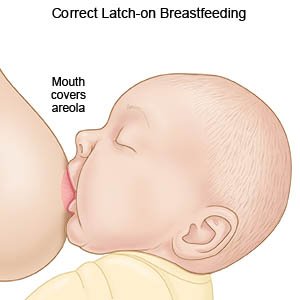
- Help your baby get a good latch. Hold the nape of his or her neck to help him or her latch onto your breast. Touch his or her top lip with your nipple and wait for him or her to open his or her mouth wide. Your baby's lower lip and chin should touch the areola (dark area around the nipple) first. Help him or her get as much of the areola in his or her mouth as possible. You should feel as if your baby will not separate from your breast easily. Gently break suction and reposition if your baby is only sucking on the nipple. Talk to a lactation consultant if you need help with your baby's latch.
- Make sure your breasts are emptied completely after feedings. Express milk with a breast pump after feedings to empty each of your breasts completely. A breast pump may also help stimulate your breasts to make more milk. Breast massage may also help stimulate your breasts and increase your milk supply. Pump your breasts every 2 to 4 hours if you are away from your baby. Pumped breast milk can be stored and used for a later feeding.
How can I care for myself while I am breastfeeding?
- Follow a healthy meal plan. A healthy meal plan provides the amount of calories and nutrients you need while you are breastfeeding. Your body needs extra calories and nutrients to keep you healthy and support milk production. A healthy meal plan includes a variety of foods from all the food groups. You also need about 8 to 12 cups of liquids each day to prevent dehydration and keep up your milk supply. Drink a beverage each time you breastfeed to help you get enough liquids. Choose liquids that do not contain caffeine. Examples are water, juice, and milk. Ask your healthcare provider for more information on breastfeeding and your diet.
- Manage your stress. Relaxation can help decrease your stress and help you feel better. Deep breathing, meditating, and listening to music also may help you cope with stress. Talk to your healthcare provider about other ways to manage stress.
- Talk to your healthcare provider before you take any medicines. This includes all prescription and over-the-counter medicines. Some medicines may enter your breast milk and affect your baby.
- Do not smoke. Nicotine goes into your breast milk. Your baby is exposed to these chemicals through breastfeeding and inhaling cigarette smoke. Do not use e-cigarettes or smokeless tobacco in place of cigarettes or to help you quit. They still contain nicotine. Ask your healthcare provider for information if you currently smoke and need help quitting.
- Limit or avoid alcohol. If you choose to drink alcohol, breastfeed your baby before you drink the alcohol. Do not breastfeed your baby for at least 2 hours after you have 1 drink. One drink of alcohol is 12 ounces of beer, 4 ounces of wine, or 1½ ounces of liquor.
- Keep a diary. Write down each time you breastfeed your baby and when you pump your breasts. Make a note of how much milk you pump out each time. You can also write down when your baby has wet or soiled diapers. A diary can help you and your healthcare provider know if your baby is getting enough milk.
Where can I go for support and more information?
- Academy of Breastfeeding Medicine
140 Huguenot
New Rochelle , NY 10801
Phone: 1- 914 - 740-2115
Phone: 1- 800 - 990-4226
Web Address: www.bfmed.org
- La Leche League International
957 North Plum Grove Road
Schaumburg , IL 60173
Phone: 1- 847 - 519-7730
Phone: 1- 800 - 525-3243
Web Address: http://www.lalecheleague.org
When should I contact my healthcare provider?
- Your baby is 4 or more days old and has fewer than 6 wet diapers each day.
- Your baby is 4 or more days old and has fewer than 3 bowel movements each day.
- Your baby is not gaining weight or looks like he or she is losing weight.
- Your baby is feeding fewer than 8 times each day or does not seem to be eating enough during each feeding.
- Your baby seems more fussy than usual or seems like he or she does not have the energy to breastfeed.
- Your breasts do not feel full, or you are not leaking breast milk within 5 days of giving birth.
- Your baby has new or increased yellowing of his or her skin or the whites of his or her eyes.
- You feel very depressed.
- You have questions or concerns about breastfeeding.
Care Agreement
You have the right to help plan how you are going to feed your baby. To help with this plan, you must learn as much as you can about breastfeeding. Ask your healthcare provider questions about breastfeeding. You can talk with him about the best way to feed your baby.The above information is an educational aid only. It is not intended as medical advice for individual conditions or treatments. Talk to your doctor, nurse or pharmacist before following any medical regimen to see if it is safe and effective for you.© Copyright Merative 2024 Information is for End User's use only and may not be sold, redistributed or otherwise used for commercial purposes.
Further information
Always consult your healthcare provider to ensure the information displayed on this page applies to your personal circumstances.
