Developmental Dysplasis Of The Hip In Children
WHAT YOU SHOULD KNOW:
Developmental Dysplasis Of The Hip In Children (Discharge Care) Care Guide
- Developmental Dysplasis Of The Hip In Children
- Developmental Dysplasis Of The Hip In Children Aftercare Instructions
- Developmental Dysplasis Of The Hip In Children Discharge Care
- Developmental Dysplasis Of The Hip In Children Inpatient Care
- En Espanol
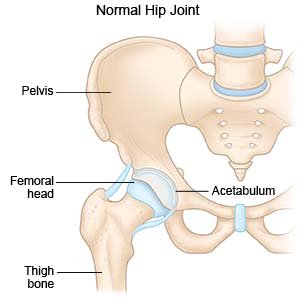
- Developmental (de-vel-up-MEN-tal) dysplasia (dis-PLAY-zhah) of the hip, or DDH, is a condition that affects your child's hips and movements. Normally, the head of the femur (thigh bone) fits into the acetabulum (cup-shaped hip socket). Together with ligaments (connective tissues that hold the bones together), they form the hip joint. With DDH, the head of your child's femur does not fit correctly into the hip socket. The head may only be slightly out of place or may not be in the hip socket at all. Sometimes, DDH occurs when the ligaments of the hip joint are loose or stretched too much. Depending on how much the hip is affected, your child may have problems walking, standing, or moving normally.
- Signs and symptoms include having hips that are unstable and pop in and out with movement. One of his legs may be shorter or longer than the other. The kneecaps may not be at the same level. Caregivers may do special movement tests, an ultrasound, or arthroscopy on your child's hip to diagnose DDH. Other tests, such as a bone x-ray, computerized tomography (CT) scan, or magnetic resonance imaging (MRI) test may also be used. Treatment of DDH depends on your child's age and how bad his hip deformity is. Treatment may include splints, casts, a closed reduction, traction, surgery, or braces. The earlier DDH is diagnosed and treated, the better your child's chance of having a full recovery.
AFTER YOU LEAVE:
Medicines:
- Keep a current list of your child's medicines: Include the amounts, and when, how, and why they are taken. Bring the list and the medicines in their containers to follow-up visits. Carry your child's medicine list with you in case of an emergency. Throw away old medicine lists. Give vitamins, herbs, or food supplements only as directed.
- Give your child's medicine as directed: Call your child's primary healthcare provider if you think the medicine is not working as expected. Tell him if your child is allergic to any medicine. Ask before you change or stop giving your child his medicines.
- Do not give aspirin to children under 18 years of age: Your child could develop Reye syndrome if he takes aspirin. Reye syndrome can cause life-threatening brain and liver damage. Check your child's medicine labels for aspirin, salicylates, or oil of wintergreen.
- Antibiotics: This medicine is given to fight an infection caused by bacteria. Give your child this medicine exactly as ordered by his primary healthcare provider. Do not stop giving your child the antibiotics unless directed by his primary healthcare provider. Never save antibiotics or give your child leftover antibiotics that were given to him for another illness.
- Pain medicine: Your child may need medicine to take away or decrease pain. Know how often your child should get the medicine and how much. Watch for signs of pain in your child. Tell caregivers if his pain continues or gets worse. To prevent falls, stay with your child to help him get out of bed.
Ask for more information about where and when to take your child for follow-up visits:
For continuing care, treatments, or home services for your child, ask for information.
Activity:
- Your child may need more rest than he realizes as he heals. Quiet play will keep your child safely busy so he does not become restless and risk hurting himself. Have your child read or draw quietly when he is awake. Follow instructions for how much rest your child should get while he heals.
- Exercise and play: Talk to your child's caregiver before you let him start exercising or playing again. Together you can plan the best exercise program for your child. It is best to start slowly and do more as he gets stronger. Exercising will help make his bones and muscles stronger.
- Riding in a car: There are special car seats and safety vests made for children in spica casts and Pavlik's harnesses. These should be used while driving in a car. Before you leave the hospital , ask where you can get a special car seat or safety vest for your child.
- Walking and home safety: Your child may need to use special braces. It is important to use braces correctly. Ask your child's caregiver for more information about using braces correctly. To keep from falling, remove loose carpeting from the floor. Using chairs with side arms and hard cushions will make it easier for your child to get up or out of a chair. You may want to put a chair or a commode inside the shower.
Assistive devices:
A caregiver will teach you how to care for a child with a brace or in a Pavlik harness or spica cast.
- Brace care: Caregivers may put a brace on your child's hips or legs to keep them from moving. It may also be used to decrease pain. Ask your child's caregiver for more information on brace care.
- Pavlik harness: Your child may have a special splint called a Pavlik harness. It has shoulder straps, a chest band, foot cuffs, and connecting straps. This holds your child's hips in the correct place and helps them grow correctly. Ask your child's caregiver for more information on proper bathing, diapering, dressing, or carrying your child.
- Spica cast: Your child may have a special spica cast. A spica cast will usually cover him from the chest down to the legs or knees. A caregiver will teach you how to diaper your child or how he can use the bathroom. Ask your child's caregiver how to clean the cast and keep it dry. Ask your child's caregiver for more information on proper bathing, dressing, and how to carry your child. Tell your child's caregiver if his toes become swollen, cold, numb (lose feeling), or turn pale or blue.
- Do's and do nots:
- Do check the skin around the brace, cast, or harness everyday. You may put lotion on sore areas.
- Do not let your child push down or lean on the cast or brace because it may break.
- Do not let your child scratch the skin under the cast by putting a sharp or pointed object inside the cast.
- Do check the skin around the brace, cast, or harness everyday. You may put lotion on sore areas.
Preventing blood clots:
Your child may be at risk for blood clots. You may help prevent blood clots by doing the following:
- Ask your child's caregiver if your child needs to elevate his legs to the level of his heart. Raising his legs will keep blood from staying in his legs and may prevent blood clots from forming.
- As pain decreases, your child may need to start moving or walking to improve blood circulation and bone healing. Ask your child's caregiver for an exercise program that may help your child fully recover.
- Make sure your child's bandages or casts are not too tight.
- Your child may need to wear support socks or stockings. These may help decrease the swelling in his legs until he is walking more. They may also prevent blood from staying in his legs, which may cause blood clots.
Rehabilitation:
Rehabilitation programs may help your child get back to or maintain activities important to his daily living. Therapists may teach him special skills to recover faster and have a better life.
- Physical therapy: Your child's caregiver may want him to do physical therapy or PT. A physical therapist will help your child with special exercises. These exercises will help make his bones and muscles stronger.
- Occupational therapy: Occupational therapy, or OT, uses self-care and play activities to help your child in his daily life. There are many ways occupational therapy may help your child become better able to take care of himself. Your child may be taught special skills used for bathing, dressing, and eating. An occupational therapist may help your child use tools to get things done at home or school. The therapist may suggest ways to keep your home or your child's school safe. You, your child, and his therapist will plan a therapy program that is right for him.
Wound care:
Ask your child's caregiver about the proper way to take care of his wound or change his bandages. It is also important to know how often your child's dressings need to be changed.
For support and more information:
Accepting that your child has DDH may be hard. You, your family, and those close to you may feel scared, sad, or angry. These are normal feelings. Talk to your child's caregivers, your family, or friends about your feelings. You may also want to join a support group. This is a group of people who may also have children with DDH. Ask your caregiver for the names and numbers of support groups near you. You may also want to contact the following organizations for more information:
- American Academy of Family Physicians
11400 Tomahawk Creek Parkway
Leawood , KS 66211-2680
Phone: 1- 913 - 906-6000
Phone: 1- 800 - 274-2237
Web Address: http://www.aafp.org
- American Academy of Orthopaedic Surgeons
6300 North River Road
Rosemont , IL 60018-4262
Phone: 1- 847 - 823-7186
Web Address: http://www.aaos.org/
- American Academy of Pediatrics
141 Northwest Point Boulevard
Elk Grove Village , IL 60007-1098
Phone: 1- 847 - 434-4000
Web Address: http://www.aap.org
CONTACT A CAREGIVER IF:
- Your child has a fever.
- Your child's pain is getting worse, even after he has taken his pain medicines.
- Your child's bandage or cast has new stains or a bad odor coming from it.
- Your child's skin is itchy, swollen, or has a rash.
- Your child cannot make it to his next appointment with his caregiver.
- You have questions or concerns about your child's condition, treatment, or care.
SEEK CARE IMMEDIATELY IF:
- Your child has trouble breathing or pain in his chest.
- Your child's splint or cast gets damaged or breaks.
- Your child's skin, toes, toenails, or the area around the hips turns blue or feels cold and numb.
- Your child's splint or cast becomes soaked with blood.
© 2013 Truven Health Analytics Inc. Information is for End User's use only and may not be sold, redistributed or otherwise used for commercial purposes. All illustrations and images included in CareNotes® are the copyrighted property of the Blausen Databases or Truven Health Analytics.
The above information is an educational aid only. It is not intended as medical advice for individual conditions or treatments. Talk to your doctor, nurse or pharmacist before following any medical regimen to see if it is safe and effective for you.
Learn more about Developmental Dysplasis Of The Hip In Children (Discharge Care)
Micromedex Care Notes:
Related encyclopedia articles: