
Caring for your Baby
Medically reviewed by Drugs.com. Last updated on Apr 2, 2024.
What do I need to know about caring for my baby?
Care for your baby includes keeping him or her safe, clean, and comfortable. Your baby will cry or make noises to let you know when he or she needs something. You will learn to tell what your baby needs by the way he or she cries. Your baby will move in certain ways when he or she needs something, such as sucking on a fist when hungry.
What should I feed my baby?
- Breast milk is the only food your baby needs for the first 6 months of life. If possible, only breastfeed (no formula) him or her for the first 6 months. Breastfeeding is recommended for at least the first year of your baby's life, even when he or she starts eating food. You may pump your breasts and feed breast milk from a bottle. You may feed your baby formula from a bottle if breastfeeding is not possible. Talk to your baby's pediatrician about the best formula for your baby. He or she can help you choose one that contains iron.
- Do not add cereal to the milk or formula. Your baby may get too many calories during a feeding. You can make more if your baby is still hungry after he or she finishes a bottle.
How much should I feed my baby?
- Your baby may want different amounts each day. The amount of formula or breast milk your baby drinks may change with each feeding and each day. The amount your baby drinks depends on his or her weight, how fast he or she is growing, and how hungry he or she is. Your baby may want to drink a lot one day and not want to drink much the next.
- Do not overfeed your baby. Overfeeding means your baby gets too many calories during a feeding. This may cause him or her to gain weight too fast. Your baby may also continue to overeat later in life. Look for signs that your baby is done feeding. Your baby may look around instead of watching you. He or she may chew on the nipple of the bottle rather than suck on it. He or she may also cry and try to wriggle away from the bottle or out of the high chair.
- Feed your baby each time he or she is hungry:
- Babies up to 2 months old will drink about 2 to 4 ounces at each feeding. He or she will probably want to drink every 3 to 4 hours. Wake your baby to feed him or her if he or she sleeps longer than 4 to 5 hours.
- Babies 2 to 6 months old should drink 4 to 5 bottles each day. He or she will drink 4 to 6 ounces at each feeding. When your baby is 2 to 3 months old, he or she may begin to sleep through the night. When this happens, you may stop waking up to give your baby formula or breast milk in the night. If you are giving your baby breast milk, you may still need to wake up to pump your breasts. Store the milk for your baby to drink at a later time.
- Babies 6 to 12 months old should drink 3 to 5 bottles every day. He or she may drink up to 8 ounces at each feeding. You may increase the time between feedings if your baby is not hungry. You may also start to feed your baby foods at 6 months. Ask your child's pediatrician for more information about the right foods to feed your baby.
How do I help my baby latch on correctly for breastfeeding?
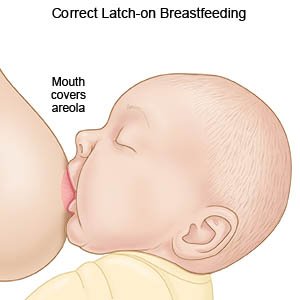
Help your baby move his or her head to reach your breast. Hold the nape of his or her neck to help him or her latch onto your breast. Touch his or her top lip with your nipple and wait for him or her to open his or her mouth wide. Your baby's lower lip and chin should touch the areola (dark area around the nipple) first. Help him or her get as much of the areola in his or her mouth as possible. You should feel as if your baby will not separate from your breast easily. A correct latch helps your baby get the right amount of milk at each feeding. Allow your baby to breastfeed for as long as he or she is able.
 |
How do I know if my baby is latched on correctly?
- You can hear your baby swallow.
- Your baby is relaxed and takes slow, deep mouthfuls.
- Your breast or nipple does not hurt during breastfeeding.
- Your baby is able to suckle milk right away after he or she latches on.
- Your nipple is the same shape when your baby is done breastfeeding.
- Your breast is smooth, with no wrinkles or dimples where your baby is latched on.
What do I need to know about feeding my baby safely?
- Hold your baby upright to feed him or her. Do not prop your baby's bottle. Your baby could choke while you are not watching, especially in a moving vehicle.
- Do not use a microwave to heat your baby's bottle. The milk or formula will not heat evenly and will have spots that are very hot. Your baby's face or mouth could be burned. You can warm the milk or formula quickly by placing the bottle in a pot of warm water for a few minutes.
How do I burp my baby?
Burp your baby when you switch breasts or after every 2 to 3 ounces from a bottle. Burp him or her again when he or she is finished eating. Your baby may spit up when he or she burps. This is normal. Hold your baby in any of the following positions to help him or her burp:
- Hold your baby against your chest or shoulder. Support his or her bottom with one hand. Use your other hand to pat or rub his or her back gently.
- Sit your baby upright on your lap. Use one hand to support his or her chest and head. Use the other hand to pat or rub his or her back.
- Place your baby across your lap. He or she should face down with his or her head, chest, and belly resting on your lap. Hold him or her securely with one hand and use your other hand to rub or pat his or her back.
How do I change my baby's diaper?
Never leave your baby alone when you change his or her diaper. If you need to leave the room, put the diaper back on and take your baby with you. Wash your hands before and after you change your baby's diaper.
- Put a blanket or changing pad on a safe surface. Lay your baby down on the blanket or pad.
- Remove the dirty diaper and clean your baby's bottom. If your baby had a bowel movement, use the diaper to wipe off most of the bowel movement. Clean your baby's bottom with a wet washcloth or diaper wipe. Do not use diaper wipes if your baby has a rash or circumcision that has not yet healed. Gently lift both legs and wash the buttocks. Always wipe from front to back. Clean under all skin folds and between creases. Apply ointment or petroleum jelly as directed if your baby has a rash.
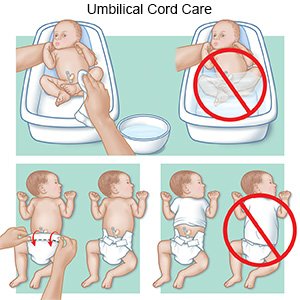
- Put on a clean diaper. Lift both your baby's legs and slide the clean diaper beneath his or her buttocks. Gently direct your baby boy's penis down as the diaper is put on. Fold the diaper down if your baby's umbilical cord has not fallen off.
 |
How do I care for my baby's skin?
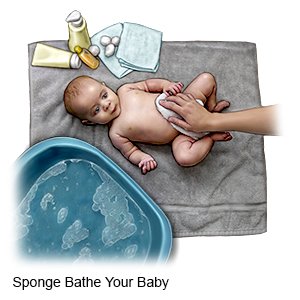
Sponge bathe your baby with warm water and a cleanser made for a baby's skin. Do not use baby oil, creams, or ointments. These may irritate your baby's skin or make skin problems worse. Ask for more information on sponge bathing your baby.
 |
- Fontanelles (soft spots) on your baby's head are usually flat. They may bulge when your baby cries or strains. It is normal to see and feel a pulse beating under a soft spot. It is okay to touch and wash your baby's soft spots.
- Skin peeling is common in babies who are born after their due date. Peeling does not mean that your baby's skin is too dry. You do not need to put lotions or oils on your newborn's skin to stop the peeling or to treat rashes.
- Bumps, a rash, or acne may appear about 3 days to 5 weeks after birth. Bumps may be white or yellow. Your baby's cheeks may feel rough and may be covered with a red, oily rash. Do not squeeze or scrub the skin. When your baby is 1 to 2 months old, his or her skin pores will begin to naturally open. When this happens, the skin problems will go away.
- A lip callus (thickened skin) may form on your baby's upper lip during the first month. It is caused by sucking and should go away within the first year. This callus does not bother your baby, so you do not need to remove it.
How do I clean my baby's ears and nose?
- Use a wet washcloth or cotton ball to clean the outer part of your baby's ears. Do not put cotton swabs into your baby's ears. These can hurt his or her ears and push earwax in. Earwax should come out of your baby's ear on its own. Talk to your baby's pediatrician if you think your baby has too much earwax.
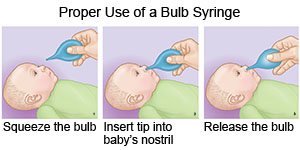
- Use a rubber bulb syringe to suction your baby's nose if he or she is stuffed up. Point the bulb syringe away from his or her face and squeeze the bulb to create a vacuum. Gently put the tip into one of your baby's nostrils. Close the other nostril with your fingers. Release the bulb so that it sucks out the mucus. Repeat if necessary. Boil the syringe for 10 minutes after each use. Do not put your fingers or cotton swabs into your baby's nose.
How do I care for my baby's eyes?
A newborn baby's eyes usually make just enough tears to keep his or her eyes wet. By 7 to 8 months old, your baby's eyes will develop so they can make more tears. Tears drain into small ducts at the inside corners of each eye. A blocked tear duct is common in newborns. A possible sign of a blocked tear duct is a yellow sticky discharge in one or both of your baby's eyes. Your baby's pediatrician may show you how to massage your baby's tear ducts to unplug them.
How do I care for my baby's fingernails and toenails?
Your baby's fingernails are soft, and they grow quickly. You may need to trim them with baby nail clippers 1 or 2 times each week. Be careful not to cut too closely to the skin because you may cut the skin and cause bleeding. It may be easier to cut your baby's fingernails when he or she is asleep. Your baby's toenails may grow much slower. They may be soft and deeply set into each toe. You will not need to trim them as often.
How do I care for my baby's umbilical cord stump?
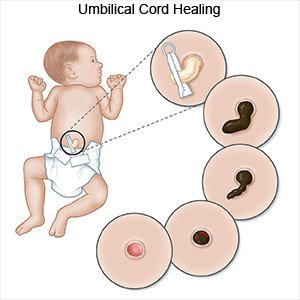
Your baby's umbilical cord stump will dry and fall off in about 7 to 21 days, leaving a belly button. If your baby's stump gets dirty from urine or bowel movement, wash it off right away with water. Gently pat the stump dry. This will help prevent infection around your baby's cord stump. Fold the front of the diaper down below the cord stump to let it air dry. Do not cover or pull at the cord stump.
 |
How do I care for my baby boy's circumcision?
Your baby's penis may have a plastic ring that will come off within 8 days. His penis may be covered with gauze and petroleum jelly. Keep your baby's penis as clean as possible. Clean it with warm water only. Gently blot or squeeze the water from a wet cloth or cotton ball onto the penis. Do not use soap or diaper wipes to clean the circumcision area. This could sting or irritate your baby's penis. Your baby's penis should heal in about 7 to 10 days.
What should I do when my baby cries?
Your baby may cry because he or she is hungry. He or she may have a wet diaper, or be hot or cold. He or she may cry for no reason you can find. It can be hard to listen to your baby cry and not be able to calm him or her down. Ask for help and take a break if you feel stressed or overwhelmed. Never shake your baby to try to stop his or her crying. This can cause blindness or brain damage. The following may help comfort your baby:
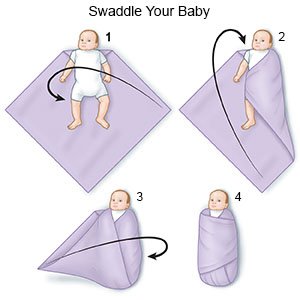
- Hold your baby skin to skin and rock him or her, or swaddle him or her in a soft blanket.
- Gently pat your baby's back or chest. Stroke or rub his or her head.
- Quietly sing or talk to your baby, or play soft, soothing music.
- Put your baby in his or her car seat and take him or her for a drive, or go for a stroller ride.
- Burp your baby to get rid of extra gas.
- Give your baby a soothing, warm bath.
How can I keep my baby safe when he or she sleeps?
- Always lay your baby on his or her back to sleep. This position can help reduce your baby's risk for sudden infant death syndrome (SIDS).

- Keep the room at a temperature that is comfortable for an adult. Do not let the room get too hot or cold.
- Use a crib or bassinet that has firm sides. Do not let your baby sleep on a soft surface such as a waterbed or couch. He or she could suffocate if his or her face gets caught in a soft surface. Use a firm, flat mattress. Cover the mattress with a fitted sheet that is made especially for the type of mattress you are using.
- Remove all objects, such as toys, pillows, or blankets, from your baby's bed while he or she sleeps. Ask for more information on childproofing.
How can I keep my baby safe in the car?
- Always buckle your baby into a child safety seat. A child safety seat is a padded seat that secures infants and children while they ride in a car. Every child safety seat has age, height, and weight ranges. Keep using the safety seat until your child reaches the maximum of the range. Then he or she is ready for the child safety seat that is the next size up. Only use child safety seats. Do not use a toy chair or prop your child on books or other objects. Make sure you have a safety seat that meets safety standards.
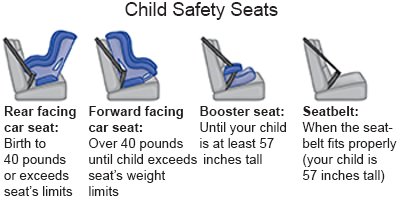
- Place your child safety seat in the middle of the back seat. The safety seat should not move more than 1 inch in any direction after you secure it. Always follow the instructions provided to help you position the safety seat. The instructions will also guide you on how to secure your child properly.
- Make sure the child safety seat has a harness and clip. The harness is made of straps that go over your child's shoulders. The straps connect to a buckle that rests over your child's abdomen. These straps keep your child in the seat during an accident. Another strap comes up from the bottom of the seat and connects to the buckle between your child's legs. This strap keeps your child from slipping out of the seat. Slide the clip up and down the shoulder straps to make them tighter or looser. You should be able to slip a finger between your child and the strap.
Call your local emergency number (911 in the US) if:
- You feel like hurting your baby.
When should I call my baby's pediatrician?
- Your baby's abdomen is hard and swollen, even when he or she is calm and resting.
- You feel depressed and cannot take care of your baby.
- Your baby's lips or mouth are blue and he or she is breathing faster than usual.
- Your baby's armpit temperature is higher than 100°F (37.8°C).
- Your baby's eyes are red, swollen, or draining yellow pus.
- Your baby coughs often during the day, or chokes during each feeding.
- Your baby does not want to eat.
- Your baby cries more than usual and you cannot calm him or her down.
- Your baby's skin turns yellow or he or she has a rash.
- You have questions or concerns about caring for your baby.
Care Agreement
You have the right to help plan your baby's care. Learn about your baby's health condition and how it may be treated. Discuss treatment options with your baby's healthcare providers to decide what care you want for your baby. The above information is an educational aid only. It is not intended as medical advice for individual conditions or treatments. Talk to your doctor, nurse or pharmacist before following any medical regimen to see if it is safe and effective for you.© Copyright Merative 2024 Information is for End User's use only and may not be sold, redistributed or otherwise used for commercial purposes.
Further information
Always consult your healthcare provider to ensure the information displayed on this page applies to your personal circumstances.
